.jpg)




Payment Gateway vs Payment Processor vs Payment Infrastructure
- Payment gateways, processors and payment infrastructure serve different roles in the payment stack; understanding these layers prevents costly architectural mistakes.
- Gateways handle customer-facing payment capture, processors manage authorisation and settlement, while infrastructure platforms support multi-currency accounts, payouts and cross-border operations.
- Most fintechs need a mix of layers; Due fits in the infrastructure layer, sitting behind your gateway to manage global money movement and payment operations at scale.
Choosing the right payment stack has become a strategic decision for fintech builders and finance leaders. Terms like payment gateway vs payment processor and payment infrastructure are often used interchangeably, yet they solve very different problems. Confusing the layers can lead to expensive mistakes; rebuilding your payment architecture after choosing the wrong vendor is time‑consuming and distracts from your core product.
According to the McKinsey Global Payments Map, global cross-border payments totalled approximately $179 trillion in 2024. As platforms expand internationally and offer payouts to sellers, contractors and employees worldwide, they need payment operations that handle multi‑currency, compliance and reconciliation at scale.
This guide breaks down the payment stack, explains what each layer does and helps you decide which components you need.
Overview: the payment stack
The modern payment stack is made up of three layers:
- Payment gateways capture payment information from customers and handle the front‑end experience.
- Payment processors connect to card networks and banks to authorise and settle transactions on the back‑end.
- Payment infrastructure manages the operational complexity of moving money across currencies and rails, including account management, foreign exchange (FX) and large‑scale payouts.
These layers fit together like building blocks. In a typical card transaction, the customer enters their details via a checkout (gateway), the transaction is authorised and cleared by the processor, and the money eventually moves between accounts through the underlying banking systems. Payment infrastructure platforms extend this chain through payment orchestration to manage multi-currency accounts, compliance, reconciliation and disbursements.
The diagram below summarises the architecture:
.png)
Understanding each layer’s responsibilities helps you make informed vendor decisions. Let’s explore them one by one.
What is a payment gateway?
A payment gateway is the front‑end technology that collects payment information from customers and passes it to the rest of the payment chain. With payment processing explained simply, the gateway enables merchants to accept card payments by acting as the front-end of the electronic payment process and transmitting customer data to the merchant’s acquiring bank. Gateways secure sensitive data through tokenisation and encryption, and often provide fraud‑prevention and 3D Secure authentication.
A payment gateway “accepts a customer’s card information, encrypts it and securely sends it to the payment processor for authorisation”. The gateway may be embedded into a website (integrated gateway) or hosted externally, redirecting customers to a third‑party checkout. Its main functions include:
- Checkout UI and tokenisation: Gateways provide the user interface for entering card details, address information and payment method selection. They use tokenisation to replace card numbers with secure tokens, reducing the merchant’s PCI compliance scope.
- 3D Secure and fraud checks: Many gateways support 3D Secure protocols and basic fraud screening, offloading risk management from merchants.
- Routing to processors: Once data is collected and initial checks pass, the gateway forwards transaction details to the appropriate payment processor.
Gateways are useful when you need a customer‑facing checkout for card or alternative payments. They enable e‑commerce, subscription billing and in‑app purchases without the merchant handling raw card data. However, a gateway does not move money, manage bank accounts or perform settlements; it simply collects and routes information.
When to use a payment gateway?
- Accepting online payments: Any business selling products or services on the internet needs a gateway to collect customer payment details securely.
- Building subscription or SaaS platforms: Gateways handle recurring billing, card vaulting and customer authentication.
- Reducing PCI compliance burden: Using a hosted checkout or tokenised gateway minimises the merchant’s exposure to cardholder data.
- Start‑ups with simple payment needs: When transaction volumes are modest and routing complexity is low, an all‑in‑one gateway/processor may suffice.
What does a payment gateway not do?
- Bank account management: Gateways don’t provide accounts or hold funds; they pass data to processors and acquirers.
- Global disbursements: Sending payouts to vendors or contractors in multiple countries requires infrastructure beyond a gateway.
- Detailed reconciliation: Gateways provide transaction‑level data, but not the operational reconciliation across payment rails that finance teams need.
What is a payment processor?
A payment processor works behind the scenes to authorise transactions and move money between banks. A payment processor takes the transaction information transmitted by the payment gateway and sends it to the card networks and issuing banks for authorisation. The processor also creates settlement files at the end of each day to finalise the movement of funds. In other words, the processor is the back‑end engine connecting merchants, acquirers, issuers and card networks.
Processors perform three core tasks:
- Authorisation: When a customer submits their card details, the processor checks with the issuing bank (via the card network) that funds are available and the transaction isn’t flagged for fraud. It then returns an approval or decline message to the merchant.
- Clearing: Once authorised, the processor prepares transactions for settlement by calculating fees and routing information between the acquiring bank and issuing bank.
- Settlement: At the end of the processing cycle (often daily), the processor moves funds from the issuing bank to the acquiring bank and eventually to the merchant’s account.
Processors connect with card networks (Visa, Mastercard, etc.), issuing banks and acquiring banks. They may also offer fraud tools at the network level. Importantly, while processors handle card transactions, they typically deal only with card and ACH rails; they don’t provide accounts, manage multi‑currency balances or handle large‑scale payouts.
When to use a dedicated processor?
- High transaction volumes: Enterprises processing tens of millions in transactions may seek direct processor relationships to optimise costs and performance.
- Custom routing logic: Businesses building their own payment service provider (PSP) or gateway may want control over network routing, retries and authorisation logic.
- Direct card network connections: Some processors offer direct integrations with card schemes, improving authorisation rates and settlement speed.
Distinction from a gateway
The processor is the courier that moves money; the gateway is the messenger that collects payment information. The gateway sends transaction details to the processor, but the payment gateway does not move money. Recognising this distinction ensures you select vendors appropriate for your use case.
What is payment infrastructure?
While gateways and processors handle front‑ and back‑end card transactions, payment infrastructure refers to the deeper layer of systems, institutions and rules that enable money movement across currencies and payment rails. Payment infrastructure is the coordinated network of technologies, financial institutions, and operating rules that securely move money from a payer to a payee, authorising, clearing and settling transactions across cards, bank transfers, digital wallets and other payment methods.
Payment infrastructure platforms go beyond card processing. They provide the tools to manage bank accounts, handle foreign exchange, orchestrate payments across multiple rails and reconcile large volumes of transactions. Core functions include:
- Multi‑currency account management: Maintaining balances in different currencies and allowing users to hold, convert and spend funds as needed.
- Global bank connections: Connecting to domestic clearing systems (ACH, SEPA, Faster Payments), card networks, SWIFT, real‑time payment schemes and even blockchain‑based rails.
- FX management and optimisation: Converting currencies at competitive rates and giving businesses visibility into FX costs.
- Payment operations and reconciliation: Tracking payments end‑to‑end, managing approval workflows, resolving failures and reconciling across multiple providers and banks.
- Payouts and disbursements: Sending high‑volume payments to recipients (sellers, contractors, employees) in multiple countries and currencies.
- Compliance and reporting: Handling know‑your‑customer (KYC), anti‑money‑laundering (AML) checks, sanctions screening and regulatory reporting.
When do you need payment infrastructure?
- Complex multi‑currency operations: Businesses that operate in several countries, collect money in one currency and pay out in another, require multi‑currency accounts, FX management and reconciliation capabilities.
- Global disbursements at scale: Marketplaces, payroll providers and gig platforms paying thousands of recipients across countries benefit from a unified payment infrastructure.
- Building financial products: Neobanks, remittance services and embedded finance platforms need back‑end infrastructure to issue accounts, move funds across rails and comply with regulations.
- High operational complexity: If you maintain multiple banking relationships or operate on several payment rails, an infrastructure layer simplifies integration and provides a single control point.
What payment infrastructure solves that gateways and processors don’t?
- Account and balance management: Infrastructure platforms provide virtual or pooled accounts in multiple currencies, whereas gateways and processors only deal with individual transactions.
- Cross‑rail flexibility: They connect to card, ACH, wire, local instant payment systems and, increasingly, stablecoin networks, giving businesses options based on speed, cost and destination.
- Reconciliation and reporting: Finance teams gain centralised views of incoming and outgoing payments, facilitating accurate books and faster close processes.
- Compliance support: Built‑in KYC/AML, sanction screening and tax reporting reduce regulatory risk.
Key differences: comparison table
The table below summarises the difference between gateway and processor, as well as payment infrastructure, across common criteria. Use it as a quick reference when evaluating vendors.
This table shows that gateways and processors solve narrow slices of the payment journey, while infrastructure platforms address broader operational and cross‑border challenges.
How do they work together?
A complete payment system often uses all three layers. The transaction flow diagram below illustrates how data and money move from a customer to the merchant and then through the banking network:
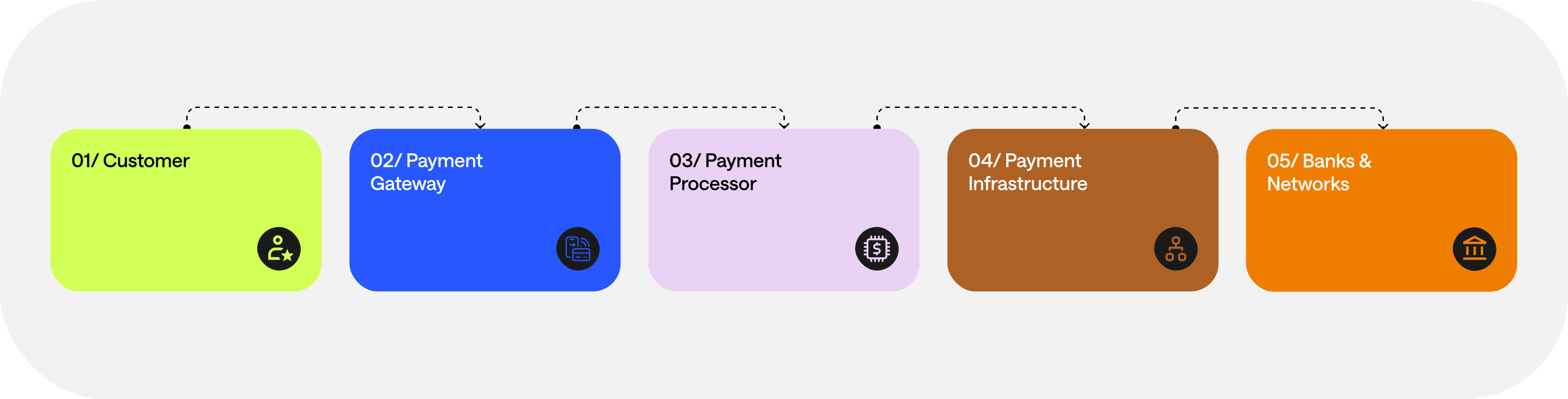
- Customer: A buyer enters payment details on an e‑commerce checkout or mobile app.
- Payment gateway: The gateway captures the data, tokenises it and performs basic fraud checks. It then forwards the transaction to the processor.
- Payment processor: The processor communicates with card networks (Visa, Mastercard, etc.) and issuing banks to authorise the transaction. If approved, it clears and settles funds with the acquiring bank.
- Payment infrastructure: For businesses operating internationally or managing multiple rails, an infrastructure layer steps in after the processor. It allocates funds to the correct accounts, handles FX conversions, orchestrates payouts and reconciles transactions across providers.
- Banks & networks: Ultimately, the transaction touches the banking system, where money is moved between accounts and networks.
Integrated versus modular providers
- Integrated providers bundle several payment layers into one platform (e.g., gateway + processor). They offer a simple setup and one contract, but limit flexibility and make switching costly.
- Modular providers specialise in a single layer, letting you assemble your own stack with best-in-class components. They require slightly more integration work but give you greater control, better optimisation, and the ability to scale across currencies, rails, and regions.
How to choose the components you need?
Selecting the right payment stack depends on your product, customer base and operational complexity. The decision tree below offers a simple framework:
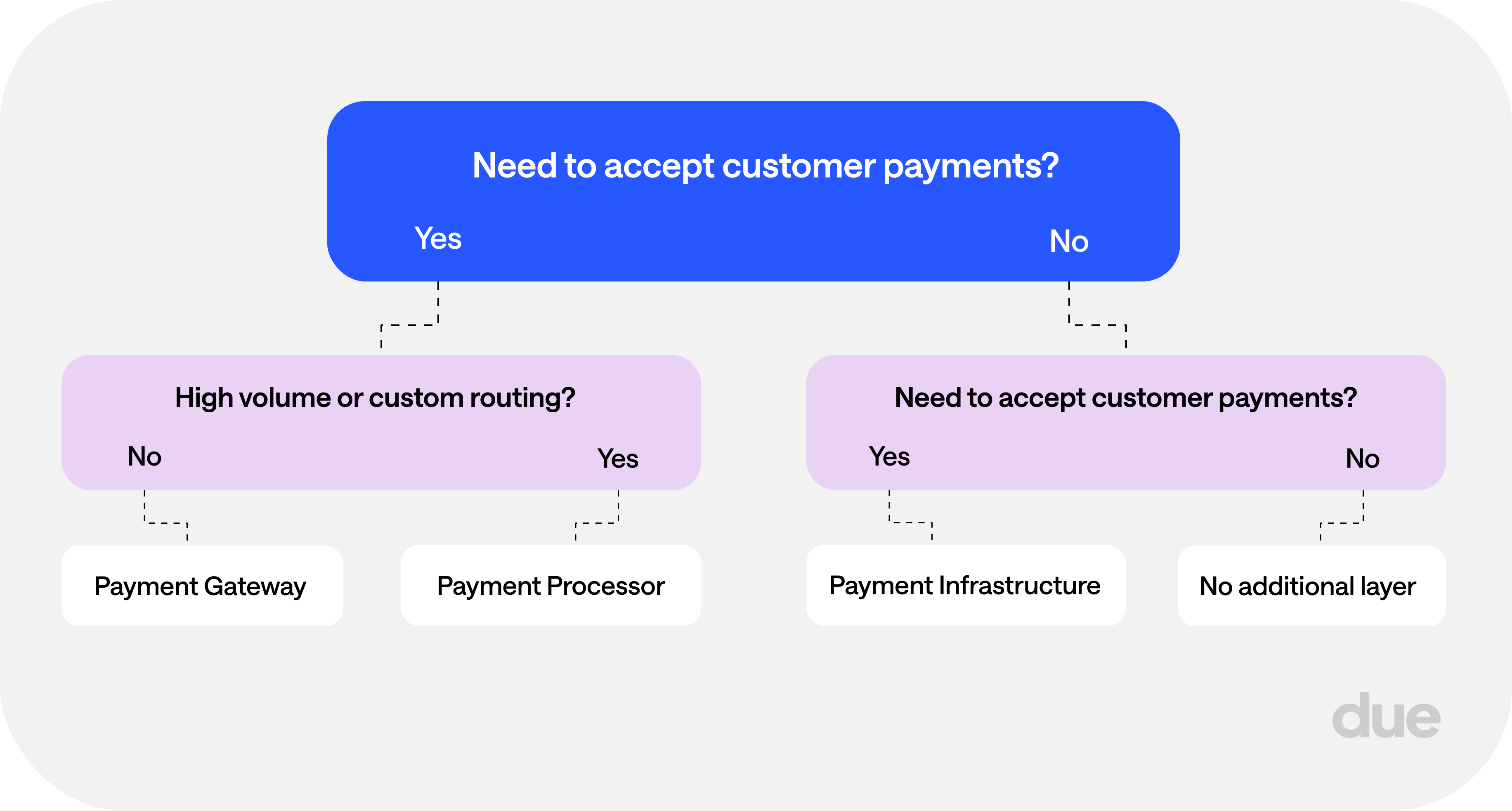
Start by asking whether you need to accept customer payments. If yes, you require a payment gateway to capture card or local payment method details. Next, consider transaction volume and routing complexity. High volumes or the need for custom routing (for example, retrying failed transactions across multiple processors) may justify a direct processor relationship. If not, a bundled gateway/processor may suffice.
If you don’t need to accept customer payments, for example, if your business focuses solely on disbursing funds, jump straight to whether you require multi‑currency accounts or global payouts. If the answer is yes, payment infrastructure is essential. If not, you may not need an additional layer at all.
When comparing providers, focus on measurable capabilities rather than marketing claims.
Evaluation criteria by layer
- Payment gateways: Check geographic and payment-method coverage, including local options in your target markets. Evaluate conversion performance, fraud tools and the quality of developer resources. A strong gateway should improve checkout completion and reduce friction.
- Payment processors: Compare pricing, authorisation rates and settlement times. High approval rates can materially lift revenue. Review reliability, SLAs and uptime history. Ensure the processor supports required card networks, local schemes and settlement currencies.
- Payment infrastructure: Assess country and currency coverage, as well as support for traditional and real-time payment rails. Strong infrastructure should offer flexible APIs for building workflows, robust reconciliation across rails and clear FX pricing. Confirm the provider’s KYC/AML capabilities and whether they support reporting requirements in relevant jurisdictions.
Where Due fits: payment infrastructure for fintechs
Due is a modern payment infrastructure provider. Rather than offering another checkout or card processor, Due focuses on the operational layer that most fintechs struggle with: multi‑currency accounts, global disbursements, compliance and reconciliation. Key features include:
- Multi‑currency virtual accounts: Hold balances in numerous currencies and move money between them seamlessly.
- Global payment rails: Access traditional rails (ACH, SEPA, wire transfers) alongside faster rails like instant payments and stablecoins. Due supports on‑chain transfers when stablecoins are appropriate, giving businesses optionality between fiat and blockchain networks.
- FX optimisation: Convert currencies at competitive rates with transparency into spreads and fees. Automated hedging tools help reduce FX exposure.
- Unified reconciliation: Consolidate incoming and outgoing payments across rails, providers and currencies into a single ledger, simplifying accounting and financial operations.
- Compliance infrastructure: Built‑in KYC/AML, sanctions screening and regulatory reporting across jurisdictions.
Due intentionally does not provide a consumer‑facing gateway or card processing. It is designed to work behind your existing payment stack. By sitting between your application and the banking system, Due manages the complexity of cross‑border payments, freeing your team to focus on product and customer experience.
Whether you are building a marketplace, payroll platform, neobank or remittance service, Due’s payment operations platform can reduce time to market and operational burden.
Book a demo to see how Due’s payment infrastructure supports global payouts, multi-currency accounts, and payment operations behind your existing stack.


FAQ
What is the difference between a payment gateway and a payment processor?
A payment gateway collects and encrypts customer payment details. A payment processor handles authorisation and settlement with banks and card networks. The gateway is front-end; the processor is back-end.
Do I need both a payment gateway and a payment processor?
Yes, if you accept card payments. The gateway captures card data; the processor moves money. Some providers offer both on one platform.
What is payment infrastructure?
Payment infrastructure is the underlying system that manages accounts, money movement, reconciliation and compliance across payment rails. It supports payouts, multi-currency balances and cross-border flows.
Is a PSP the same as a payment gateway?
No. In the PSP vs payment gateway comparison, a PSP (payment service provider) offers a full stack, including gateway, processing and often settlement. A gateway is only one part of that stack.
How do I choose between a payment gateway, processor or infrastructure provider?
Choose a gateway to accept customer payments. Choose a processor for high-volume or advanced routing. Choose infrastructure if you run global payouts, multi-currency accounts or complex payment operations.