



FX Spreads and Hidden Cross‑Border Payment Costs
- FX spreads add 0.5-5% to cross-border payments and are often 10x larger than transaction fees. On a $100,000 transfer, a 3% spread costs $3,000 compared to a typical $25-50 wire fee.
- Calculate your actual cost by comparing your provider's rate to the mid-market rate from sources like XE or Reuters. Multiply the percentage difference by your transaction amount to see hidden FX costs.
- Traditional banks charge 3-5% spreads, money transfer services charge 1-3%, fintech platforms charge 0.5-1.5%, and stablecoin rails charge 0.5-2% on-ramp/off-ramp fees. Provider choice directly impacts total cost.
FX spreads add 0.5-5% to cross-border payment costs, often 10x more than the transaction fee listed in your contract. Most providers don't disclose their FX markup, making it the largest hidden cost in international payments. This guide explains how FX spreads work, what transparency regulations require providers to disclose, and how to calculate your actual markup.
What is an FX spread?
An FX spread is the difference between the rate a payment provider offers you and the mid-market rate (the real exchange rate between two currencies at any moment). Providers buy currency at one price and sell it to you at a higher price. That difference is their markup.
Example: If the mid-market rate for USD/EUR is 0.9200 and your provider charges 0.9400, the spread is 200 basis points or 2.17%. On a $100,000 payment, that's $2,170 in hidden costs on top of any transaction fees.
FX spreads are often larger than transaction fees but harder to spot because:
- Most contracts don't specify the markup
- Rates change constantly, making comparisons difficult
- Providers may advertise "no fees" while charging 3-5% spreads
- The markup isn't itemized separately on invoices
Common hidden costs in cross‑border payments
Exchange rates are just one part of the puzzle. Cross‑border payments travel through a web of correspondent banks, card networks and messaging systems, each charging fees. Hidden costs typically fall into three buckets:
1. FX markup
This is the highest cost. Banks often mark up the rate 2–5% above mid‑market, meaning a $100 000 transfer could cost $2 000–$5 000. Some remittance services charge up to 6% when sending cash. Fintech platforms usually add 0.5–1.5%, while stablecoin rails charge about 0.5–1% on each side of the conversion.
2. Intermediary bank fees
When funds travel via the SWIFT network, they often pass through intermediary or correspondent banks. These banks deduct lifting fees, typically $15–$50, from the transfer before it reaches the recipient. Because fees are deducted mid‑route, the sender may not know the exact amount the recipient will receive.
3. Network fees
Card networks and messaging systems levy their own charges. Visa charges 1.10% to 2.00% interchange fees (depending on card type) when foreign-issued cards are used at U.S. merchants. Mastercard interchange fees for international transactions vary by card type and merchant category, with interregional transactions typically ranging from 1.5% to 2.5% depending on the card tier (basic, premium, commercial) and transaction type.
Our hidden cost breakdown infographic summarises how much each category can contribute to the total cost:

How providers structure FX markups
Providers use several pricing models:
- Percentage-based spread: A fixed markup over mid-market rate regardless of transaction size. Common for smaller fintechs and neobanks. Typically ranges from 0.5-3% depending on currency pair liquidity.
- Tiered pricing: Spreads decrease as transaction volume increases. Enterprise customers might get 0.3-0.5% spreads while smaller customers pay 2-3%. Volume thresholds and corresponding rates should be specified in contracts but often aren't
- Dynamic pricing: Spreads vary based on currency pair, market volatility, and transaction timing. More liquid pairs (USD/EUR, USD/GBP) typically have tighter spreads (0.3-1%) while exotic pairs can reach 3-5%. This model is most common among banks and large FX providers.
- Fixed-rate windows: Some providers lock rates for 24-48 hours, absorbing volatility risk in exchange for wider spreads. This reduces uncertainty but typically costs 0.5-1% more than spot pricing.
What drives spread variation
FX spreads vary based on:
- Currency pair liquidity: Major pairs (USD/EUR, USD/GBP, USD/JPY) trade in high volume with narrow spreads. Emerging market currencies (ZAR, BRL, MXN) have less liquidity and wider spreads. Exotic pairs (KZT, UZS, LAK) may have spreads exceeding 5%.
- Transaction size: Larger transactions typically qualify for better rates because providers can more easily hedge their exposure. The threshold for wholesale rates varies by provider but often starts at $100,000-250,000 per transaction.
- Market volatility: Spreads widen during periods of high volatility (market crashes, geopolitical events, major economic announcements) as providers hedge against rapid rate changes. This is temporary but can double normal spreads during extreme events.
- Customer segment: Banks often charge higher spreads to retail and small business customers (2-4%) while offering institutional clients near-interbank rates (0.1-0.3%). Fintech providers may have flatter pricing across segments.
How to calculate your provider's FX spread
Most providers don't disclose their markup percentage, but you can calculate it. Use the mid‑market rate as your anchor, plug in the numbers and see what you’re actually paying:
Step 1: Find the mid‑market rate
Check financial news sites or currency converters to get the real market price. On 12 December 2025, the EUR/USD mid‑market rate was 1.1738.
Step 2: Note the provider’s rate
Suppose your bank offers 1.1386 USD per EUR for a EUR→USD transfer. This rate is about 3% worse than the mid‑market rate.
Step 3: Calculate the percentage difference (spread)
Use the formula:
Spread (%) = ((Mid‑market rate − Provider rate) / Mid‑market rate) × 100
In our example:
((1.1738 − 1.1386) / 1.1738) × 100 ≈ 3.0 %
Step 4: Calculate the FX cost
Multiply the spread by the amount you’re exchanging. If you’re converting $100 000 at a 3 % spread:
FX cost = $100 000 × 3 % = $3 000
Step 5: Add explicit fees
Include any transfer fees, SWIFT fees or card network charges. Assume $25 for this example.
Step 6: Determine the total cost
Add the FX cost and explicit fees:
Total cost = $3,000 (FX cost) + $25 (fees) = $3 025
The percentage of your transfer lost is 3.025%. This method works for any currency pair; just update the mid‑market rate and provider quote.

What regulations require providers to disclose
FX transparency requirements vary by jurisdiction. Some regulations mandate disclosure, others don't.
European Union: PSD2 and MiCA
The EU's Payment Services Directive 2 (PSD2) requires payment providers to disclose:
- The exchange rate used or reference rate if the rate isn't yet determined
- Any charges, fees, and markups applied to the exchange
- The total amount received by the beneficiary after all deductions
Article 45 of PSD2 specifically requires transparency on currency conversion charges. Providers must show the conversion rate and all fees before the payer authorizes the transaction.
The EU's Markets in Crypto-Assets Regulation (MiCA) extends similar transparency requirements to stablecoin transactions, requiring disclosure of any spread between market rate and offered rate.
United States: CFPB remittance rule
The Consumer Financial Protection Bureau's Remittance Rule (Regulation E, 12 CFR 1005.30) requires providers sending consumer remittances to disclose:
- The exchange rate used (or an estimate if the exact rate isn't yet known)
- Any fees charged by the provider
- The amount that will be received by the beneficiary in local currency
This rule applies to consumer remittances over $15. It doesn't cover B2B transactions, which have no federal disclosure requirements.
United Kingdom: FCA transparency rules
The UK Financial Conduct Authority's Payment Services Regulations 2017 (implementing PSD2) require similar disclosure to EU rules. Providers must show:
- Exchange rate or reference rate methodology
- All charges, including FX margin
- Total amount after conversion and fees
Other jurisdictions
Most jurisdictions don't require explicit FX spread disclosure for B2B payments:
- Australia: No specific FX transparency requirements for business payments
- Singapore: No mandatory FX spread disclosure
- Canada: Limited disclosure requirements under federal payments regulations
- UAE: No FX transparency requirements
This regulatory gap means businesses often have no contractual right to know their provider's FX markup.
Comparing providers on FX transparency
Different providers use different pricing models. The chart below summarises typical FX spreads by provider type:
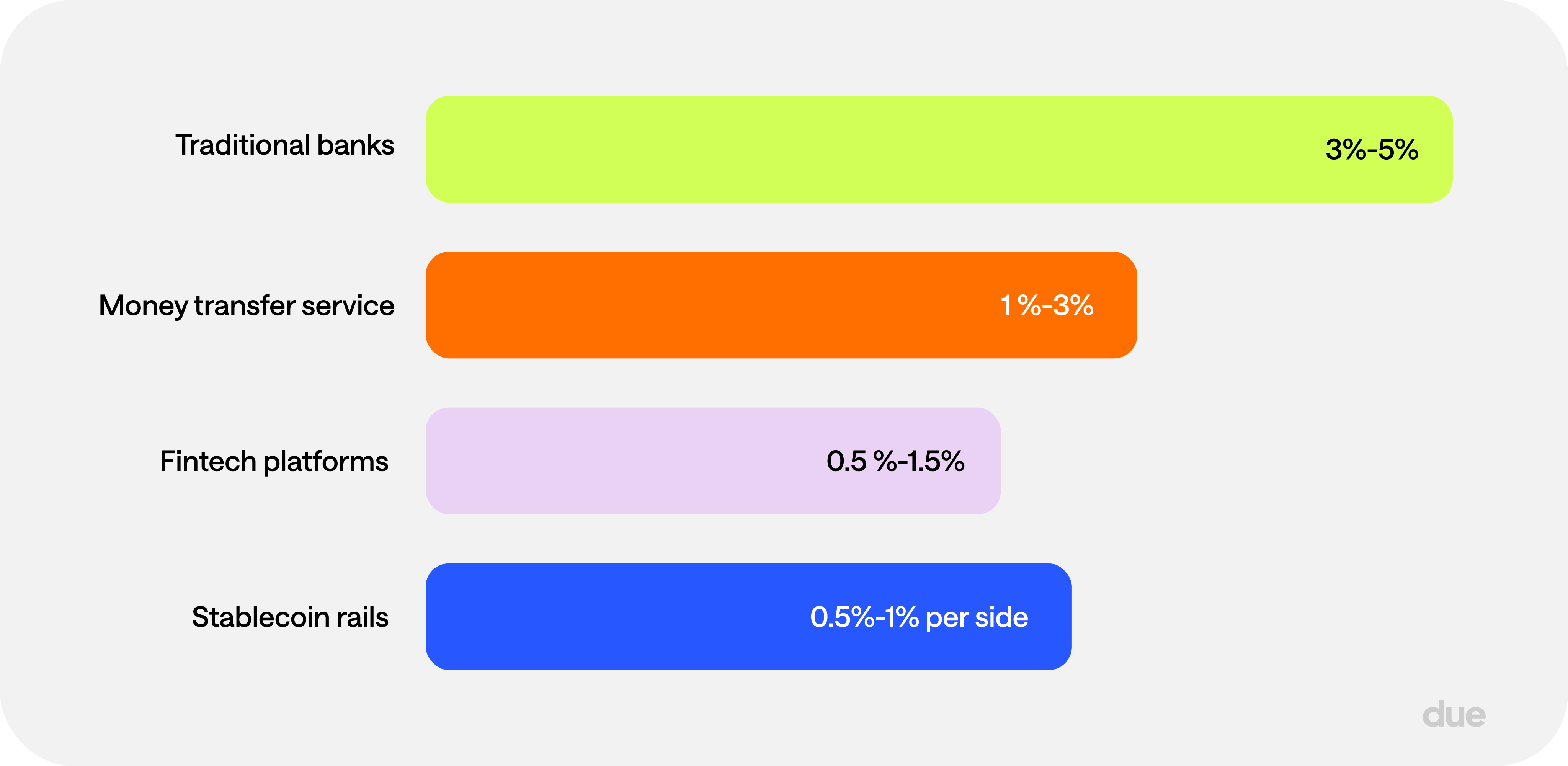
Traditional banks
Banks offer convenience but charge the highest spreads. Studies show banks routinely apply a 3–5% markup on a $100 000 transfer that translates to $2 000–$5 000. They also charge wire fees ($15–$50) and may apply an extra FX transaction fee of about 1 %. Banks rarely disclose the mid‑market benchmark, so it’s hard to see your cost.
When to use: Complex treasury operations that require bundling cash management with hedging and financing. Banks can handle large volumes, but their pricing suits corporates that can negotiate better terms.
Money transfer services
Consumer remittance companies focus on ease of use. They typically charge a 1–3% FX spread and a small flat fee. Some cash‑pickup services charge up to 6%. They may display a lower headline fee while hiding the markup in the rate.
When to use: Individual remittances or occasional small transfers where speed matters more than cost. Always check the total delivered amount.
Fintech platforms
Modern platforms use technology and local banking relationships to minimise spreads. Typical FX margins are 0.5–1.5%. Some platforms offer near‑mid‑market rates for certain currency corridors and charge transparent fees. They often provide multi‑currency accounts, local routing numbers and API‑driven integration, making them ideal for marketplaces and global businesses.
When to use: Regular business payments, global payroll, marketplace payouts or supplier payments where transparency and lower spreads are vital.
Stablecoin rails
Stablecoins such as USDC, USDT and PYUSD allow value to move on public blockchains. On‑ramping from fiat to stablecoin typically costs 0.5–2% and off‑ramping back to fiat costs 0.5–3%. Because stablecoins represent digital dollars or euros, there is no FX conversion if both sides transact in the same stablecoin. Using stablecoin rails can eliminate cross‑border bank and network fees, but requires trust in the on‑/off‑ramp providers and regulatory compliance. For a practical explanation of how onchain FX can separate conversion from the payment route, see Altitude's guide to onchain FX and fee leakage.
When to use: High‑frequency transfers, instant settlement and corridors where traditional banking is costly or unreliable. Use stablecoins when both sender and recipient can hold and spend the digital currency, and ensure you understand on‑ramp/off‑ramp spreads and regulatory considerations.
How to reduce FX costs with Due
Due’s payment operations platform integrates payment acceptance, global payouts and FX conversion. Here’s how it helps businesses control FX costs:
- Clear FX markup. Due discloses the mid‑market reference rate and its margin before you confirm a payment, complying with EU and US transparency regulations. There are no hidden correspondent bank fees; if a third‑party bank charges a lifting fee, you see it in advance.
- Stablecoin option. For corridors where both parties can receive stablecoins, Due lets you settle in USDC or other regulated stablecoins, eliminating FX conversion. On‑ramp and off‑ramp spreads are around 0.2–0.3% for B2B payments. Much lower than bank FX markups.
- Multi‑currency virtual accounts. Due to issues with local IBANs and account numbers in major currencies, you can pay or receive funds in the local currency, avoiding double conversions.
- Orchestration layer. With connections to multiple acquiring banks, Due routes transactions for the best approval rate and cost. This reduces declines and ensures you always get the most competitive rate.
- Transparent reporting. Detailed dashboards show the mid‑market rate, the FX markup, all fees and the exact amount the recipient will receive, helping finance teams reconcile payments and forecast costs accurately.
Book a demo to see how Due can cut your FX costs and simplify your cross‑border payments.
Disclaimer: Foreign exchange spreads, FX spreads, and fees change constantly. Always check the mid-market rate and the full fee breakdown at the exact time of your transaction before confirming any cross-border payment.


FAQ
Why does my €100 000 payment arrive short even when there’s “no FX fee”?
Because the cost is built into the exchange rate, your provider likely applied an FX spread by offering a rate worse than the mid-market rate. That difference is the real fee, even if no separate FX charge appears on the invoice.
Where exactly do banks hide FX costs on international payments?
Banks usually hide FX costs inside the exchange rate itself, not as a line item. You see the loss only after settlement. Additional deductions may also appear from intermediary banks or network fees, making it hard to reconcile the true cost without comparing rates manually.
How do I prove to my team that FX spread is the main cost driver?
Take one transaction and compare the provider’s rate to the mid-market rate at the same time. Multiply the percentage difference by the payment amount. This calculation usually shows FX spread costs exceeding transfer fees, SWIFT charges, and other visible costs combined.
Why do different payment providers quote very different FX rates?
Each provider uses a different pricing model within their payment infrastructure. Some rely on FX spreads for margin, others charge explicit fees. Payment orchestration and modern payment operations platforms often offer tighter spreads because they route payments more efficiently across multiple providers.
When does it actually make sense to avoid FX conversion entirely?
It makes sense when you pay suppliers or sellers repeatedly in the same currency. Holding funds in multi-currency accounts or using stablecoin rails can remove FX spreads altogether. This only works if your payment stack and payment service provider support local settlement properly.
https://remittanceprices.worldbank.org/
https://www.mycurrencycost.com/blog/5-ways-banks-mark-up-foreign-exchange-rates/
https://www.grandviewresearch.com/industry-analysis/cross-border-payments-market-report
https://usa.visa.com/dam/VCOM/download/merchants/visa-usa-interchange-reimbursement-fees.pdf
https://eur-lex.europa.eu/EN/legal-content/summary/cross-border-payments-in-the-european-union.html