



What happens to stablecoins when the GENIUS Act takes effect
- From January 18, 2027, only approved issuers can issue payment stablecoins in the US. No issuer is approved yet, so existing issuers depend on OCC waivers.
- January 18 is mainly an issuer deadline. The ban on platforms offering unapproved stablecoins to US users starts on July 18, 2028.
- Most implementing rules are still unfinished. Fintechs should track which stablecoins they hold and who issues them, not rebuild their stack.
On January 18, 2027, issuing a payment stablecoin in the US without approval becomes a federal crime. For fintechs that hold or move stablecoins, including the platforms that settle payouts through Due, the date raises a practical question: do the stablecoins we use keep working?
The timing makes that hard to answer. The OCC finished its rule in October, but it is not yet accepting applications, so no issuer has been approved. Three other federal regulators have not finalized their rules at all.
The short answer is that existing stablecoins have a path to keep operating, and the bigger change for platforms comes in July 2028. This guide covers what changes on January 18, how the waiver process works, which rules are still pending, and what to check before each deadline.
What changes when the GENIUS Act takes effect on January 18, 2027
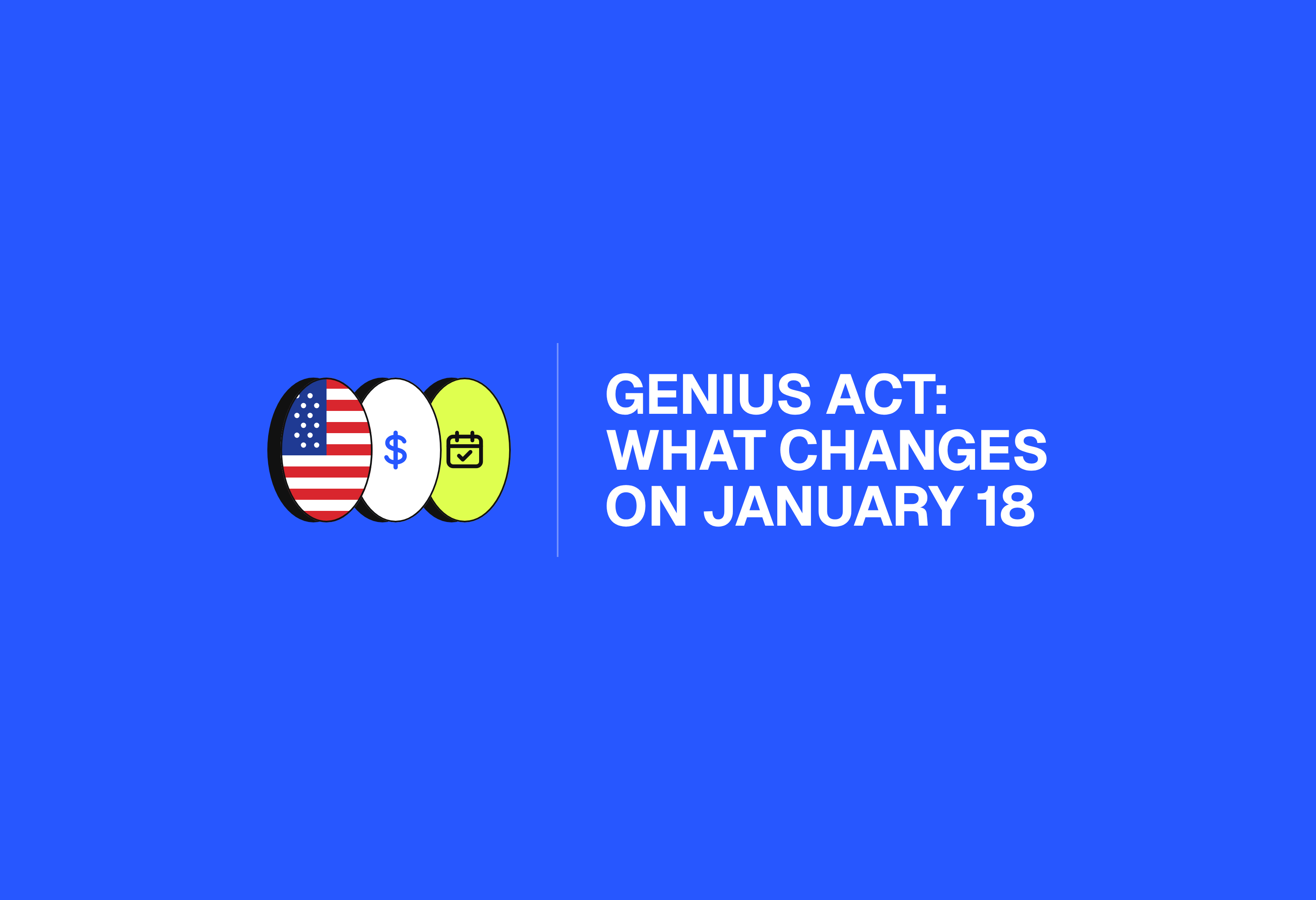
The GENIUS Act takes effect on the earlier of two dates: 18 months after it was signed on July 18, 2025, or 120 days after the federal regulators issue their final rules. The Federal Reserve, FDIC and NCUA have not finalized theirs, so the 18-month date applies: January 18, 2027.
From that day, four rules apply to issuers and the stablecoins they put in circulation:
- Issuers need approval. A person generally must be approved as a permitted payment stablecoin issuer (PPSI) to issue a payment stablecoin in the US. Federal regulators approve most issuers. State regimes can license smaller ones, up to $10 billion in outstanding issuance.
- Issuing without approval is a crime. Anyone who knowingly takes part in unapproved issuance faces fines of up to $1 million per violation, up to five years in prison, or both.
- Reserves and redemption rules apply. Approved issuers must back each coin with eligible reserves, honor redemption at par and publish their reserve composition every month.
- Issuers cannot pay yield. Approved issuers may not pay holders interest or yield just for holding the stablecoin.
One rule also reaches platforms on day one. A digital asset service provider may only offer a stablecoin from a foreign issuer if that issuer has the technical ability to comply, and will comply, with lawful orders from US authorities.
Why no stablecoin issuer is approved under the GENIUS Act yet
No issuer has been approved yet because the application process has not opened. The OCC issued its final rule on October 21, 2026, but it will only take applications once the Office of Management and Budget approves its application forms.
The timeline is tight:
- November 23, 2026: public comments on the OCC's application forms close.
- After OMB approval: the OCC announces by press release that it is accepting applications and waiver requests.
- January 18, 2027: the law takes effect, and the deadline for a pending application to support a waiver.
Lawyers tracking the process expect the filing window to be only a few weeks long, falling over the holidays. Few if any approvals are likely to land before the deadline, which is why the waiver matters.
How GENIUS Act waivers keep existing stablecoins running
The waiver is a bridge for issuers that already operate in the US. It lets them keep issuing while the OCC reviews their application, as long as they filed in time.
The OCC's waiver bulletin sets the terms:
- Who qualifies: existing issuers with a substantially complete application pending on January 18, 2027. That covers subsidiaries of insured banks and applicants to become federal qualified issuers.
- How long it lasts: up to 12 months from January 18, 2027, so no waiver runs past January 18, 2028.
- How likely it is: the OCC “generally expects to grant” waivers to existing US issuers. Issuers not yet operating in the US should expect to wait for full approval.
- What happens without one: an existing issuer that keeps issuing without a waiver or approval could breach the law, even if it applied on time.
A waiver is not an approval, and the OCC can still deny the underlying application. Issuers licensed by a state follow a separate track, with initial state certifications due by January 18, 2028. Treasury's proposed safe harbor covers issuers with pending federal applications, not state ones, and on November 18 six senators from both parties asked Treasury to extend it to state-supervised issuers.
For a fintech, the practical signal is simple. When the OCC opens applications, watch for the issuers behind the stablecoins you use to confirm they have filed and received a waiver.
What the GENIUS Act does not change for fintechs on January 18
Most of what fintechs do with stablecoins carries on after January 18. The day-one rules target issuance, not the platforms that hold, send or settle with stablecoins.
Three things stay the same on that date:
- Platforms can still offer existing stablecoins. The ban on offering unapproved stablecoins to US users starts on July 18, 2028, three years after the law was signed. The foreign issuer condition above is the exception.
- Self-custody transfers are outside the section. The rules do not apply to direct transfers between two people without an intermediary, or to transactions through self-custody wallets.
- GENIUS-specific AML rules are not final. FinCEN's anti-money-laundering and sanctions rules under the Act, and the joint customer identification rule, are still proposals.
What to check before January 18
A short review now makes each later deadline easier. For each stablecoin you hold, accept or offer:
- Name the issuer and where it is licensed: a federal regulator, a state, or outside the US.
- Confirm whether the issuer plans to apply to the OCC or a state before January 18.
- If the issuer is foreign, check whether it has said it can comply with US lawful orders.
- Note which flows touch US users, since those are the ones the July 2028 rule covers.
- Ask your payment providers how they will handle a stablecoin that loses its waiver or is denied approval.
Which GENIUS Act rules are still pending
Only one of the four federal banking regulators has a final rule. The rest of the framework, including how states qualify and how foreign stablecoins are treated, is still being written.
The table shows where each rulemaking stands as of November 20, 2026, based on Gibson Dunn's tracker. We will update it as rules are finalized.
| Regulator | What it covers | Status |
|---|---|---|
| OCC | Licensing and standards for OCC-supervised issuers | Final rule issued October 21, 2026. Applications not yet open |
| Federal Reserve | Standards for Fed-supervised issuers and bank applications | Proposed September 29, 2026. Comments due November 30, 2026 |
| FDIC | Standards and applications for FDIC-supervised issuers | Proposed. Final rule pending |
| NCUA | Rules for credit union issuers | Proposed. Final rule pending |
| Treasury | Principles for state regimes, foreign comparability, de minimis safe harbor | Proposed or not yet issued |
| FinCEN | AML and sanctions programs, customer identification | Proposed. Final rules pending |
These gaps matter for fintechs. Until Treasury finalizes how foreign regimes are judged comparable, there is no settled path for stablecoins issued outside the US to be offered to US users after July 2028.
Why July 2028 is the bigger GENIUS Act deadline for fintechs
January 18 is the issuer deadline. The date that changes how platforms operate is July 18, 2028.
From that day, a digital asset service provider may not offer or sell a payment stablecoin to a person in the US unless an approved issuer issued it. The exceptions are stablecoins from foreign issuers that meet Treasury's comparability and reciprocity terms, and any limited safe harbors Treasury creates.
The Act defines digital asset service providers broadly, covering businesses that exchange, transfer or hold digital assets for customers in the US. Whether a given payout, wallet or exchange model falls inside that definition depends on the facts, so it is worth a legal read well before 2028.
The timeline puts the issuer and platform deadlines side by side.
GENIUS Act timeline
Issuers face the deadline in January 2027, platforms in July 2028
July 18, 2025
GENIUS Act signed into law
October 21, 2026
OCC issues its final rule. Applications not yet open
January 18, 2027
Act takes effect for issuers
Issuers need approval or a waiver to keep issuing in the US
July 18, 2027
Treasury's target to complete reciprocal arrangements with foreign regimes
January 18, 2028
Last waivers expire. Initial state certifications due
July 18, 2028
Platforms can't offer unapproved stablecoins to US users
Applies to digital asset service providers, with limited exceptions
Two dates sit in between. Treasury has a statutory target of July 18, 2027 to complete reciprocal arrangements with foreign regimes. On January 18, 2028, the last waivers expire and initial state certifications are due.
How Due fits into stablecoin payments under the GENIUS Act
Due is a payments API, not a stablecoin issuer. Platforms use one integration to move money between stablecoins and local bank rails in 80+ countries. The issuer rules above shape which stablecoins move through that flow.
On the regulatory side, Due holds MiCA authorization from Spain's CNMV, the EU's framework for crypto-asset service providers. For a wider view of how other markets regulate stablecoins, see our stablecoin regulation guide.
We will update this article as the OCC opens applications, waivers are granted and the remaining rules are finalized.
Book a demo to see how Due handles stablecoin and local currency payouts through one API.


GENIUS Act effective date FAQ
When does the GENIUS Act take effect?
On January 18, 2027. The law takes effect 18 months after it was signed, or 120 days after regulators finalize their rules, whichever comes first. Three federal regulators have not finalized theirs, so the 18-month date applies.
Is any stablecoin issuer approved under the GENIUS Act yet?
No. As of November 20, 2026, the OCC is not accepting applications or waiver requests. It will start once the Office of Management and Budget approves its application forms.
Can fintechs keep using existing stablecoins after January 18, 2027?
In most cases, yes. Issuers that file a substantially complete application by January 18 can request a waiver of up to 12 months. Platforms are not barred from offering unapproved stablecoins to US users until July 18, 2028.
What happens if an issuer misses the January 18 deadline?
It cannot keep issuing in the US without approval or a waiver. Knowingly issuing without approval can bring fines of up to $1 million per violation and up to five years in prison.
Do the midterm results change the GENIUS Act timeline?
No. The January 18, 2027 effective date and the July 18, 2028 deadline for platforms are written into the law, so changing them would take new legislation. The new Congress convenes on January 3, 2027 and can hold oversight hearings, but the rules themselves are being written by regulators such as the OCC, Treasury and FinCEN.