



India's payment systems explained: UPI, IMPS, NEFT and RTGS
- UPI and IMPS credit recipients in seconds, 24/7, and carry most payouts. NEFT settles in half-hourly batches, and RTGS takes single payments of ₹2 lakh or more.
- Foreign money enters India through a licensed channel before it reaches a domestic rail. That channel sets the limits, the reporting and the documents the recipient gets.
- Before choosing an India payout provider, check its rails and limits, how it classifies inbound payments, and how it handles purpose codes.
India received $150.7 billion (USD) in personal remittances in 2025, more than any other country, according to World Bank data. That money reaches recipients over four domestic rails: UPI, IMPS, NEFT and RTGS. Due pays out rupees over two of them, UPI and IMPS, so the choice of rail shapes how fast each payout lands and what can go wrong.
The rails themselves are well documented. The harder part sits one layer up. Money from abroad has to enter India through a licensed channel before it touches a domestic rail, and that channel sets the limits, the reporting and the paperwork the recipient gets.
This guide covers who runs each rail, how UPI, IMPS, NEFT and RTGS compare on speed and limits, how inbound money reaches Indian accounts, and what to check before you pick an India payout provider.
Who runs India's payment systems: RBI and NPCI
Two institutions run India's main payment rails. The Reserve Bank of India (RBI) owns and operates NEFT and RTGS. The National Payments Corporation of India (NPCI) operates UPI and IMPS.
The split matters because the two pairs settle differently. NPCI clears UPI and IMPS payments, nets each bank's position, and settles those amounts across the banks' RTGS accounts at RBI, according to NPCI's settlement process. The recipient is credited in seconds, while the interbank settlement between banks happens later in cycles. RTGS settles each payment in full as it happens, and NEFT settles in batches.
The four rails also split the market in an unusual way. UPI carries most payments by count, while RTGS carries most of the money, as RBI's figures for fiscal 2025-26 (April 2025 to March 2026) show.
Source: RBI, payment system indicators for FY2025-26. Shares are of all payment systems tracked by RBI, so the rows do not sum to 100%.
A note on units: Indian rules state amounts in lakh and crore. One lakh is 100,000 and one crore is 10 million, so ₹2 lakh (INR) is ₹200,000.
How UPI works: instant payments, UPI IDs and limits
UPI (Unified Payments Interface) is NPCI's real-time rail for account-to-account payments, live since August 2016 and available 24/7, according to a government fact sheet from August 2026. It processed 24.07 billion transactions worth ₹29.37 lakh crore in September 2026, per NPCI data reported by DD India. For payouts under ₹1 lakh, it is the default rail.
A UPI payment can be addressed in two main ways, according to NPCI's UPI FAQ:
- A UPI ID (also called a virtual payment address), such as name@bank
- A bank account number plus the branch's IFSC (Indian Financial System Code)
The UPI ID hides the account details from the payer. For a payout platform, that means fewer mistyped account numbers, but it also means you need to validate the ID before you send.
UPI transaction limits
UPI's limits depend on the type of payment, so the payout flow decides which cap applies. The main ones are:
- Person-to-person: ₹1 lakh per transaction, per NPCI
- Selected merchant categories: ₹5 lakh per transaction since September 15, 2025, including capital markets, insurance, travel and business collections, per Business Standard
Above these caps, a payout has to move to IMPS, NEFT or RTGS.
Recent UPI rule changes that affect operators
NPCI tightened how apps and payment providers use UPI in 2025. Two changes matter for payout flows:
- Status checks: Since August 1, 2025, a transaction's status can be checked three times, at least 90 seconds apart, per SCC Online
- Collect requests: Person-to-person collect requests ended on October 1, 2025, while merchant collect requests continue, per Business Today
The status-check limit is the one to design around. Reconciliation logic that polls aggressively for a final status will hit the cap, so rely on callbacks where your provider offers them.
How IMPS works: instant transfers by account number and IFSC
IMPS (Immediate Payment Service) is NPCI's older instant rail. It went live on November 22, 2010 and runs 24/7, according to NPCI. It is the instant option for payouts above UPI's ₹1 lakh cap, up to ₹5 lakh per transaction.
IMPS uses the same settlement model as UPI: the recipient is credited in seconds and NPCI settles between banks afterwards, as described in NPCI's IMPS product booklet. The difference is in addressing and limits:
- Addressing: Account number plus IFSC, or the recipient's mobile number plus a seven-digit Mobile Money Identifier (MMID)
- Limit: ₹5 lakh per transaction, raised from ₹2 lakh in October 2021 under NPCI circular OC-103
- Channels: Mobile, internet banking, bank branches, ATMs and SMS (SMS and voice payments stay capped at ₹5,000)
IMPS volume is shrinking while UPI grows. It handled 4.94 billion transactions worth ₹76.7 lakh crore in FY2025-26, down from 6.01 billion in FY2023-24, according to RBI's 2025-26 annual report. The value per transaction is far higher than on UPI, which fits its role as the rail for larger instant transfers.
For payouts, the practical rule is simple. If you have a UPI ID and the amount is under ₹1 lakh, UPI works. If you only have an account number and IFSC, or the amount is between ₹1 lakh and ₹5 lakh, IMPS is the instant route. Both run on the real-time payment model, so the recipient sees funds in seconds either way.
NEFT vs RTGS: batch transfers and high-value settlement
NEFT and RTGS are both run by RBI and both operate 24/7. NEFT settles in half-hourly batches with no RBI-set minimum or maximum, while RTGS settles each payment individually and in real time, with a ₹2 lakh minimum.
NEFT: half-hourly batches with no RBI limit
NEFT (National Electronic Funds Transfer) has run 24/7 since December 16, 2019, in 48 half-hourly batches a day, under RBI circular RBI/2019-20/111. The same circular requires banks to credit the beneficiary, or return the funds, within two hours of the batch settling. If you want to know how batch timing changes cash flow, our guide to payment settlement cycles covers it.
Three other rules shape how NEFT behaves:
- No RBI limits: RBI sets no minimum or maximum, though banks can set their own, per RBI's NEFT FAQ
- Free for savers online: Online NEFT from savings accounts has been free since January 1, 2020, under RBI circular RBI/2019-20/116
- Name lookup: Since April 1, 2025, banks must let senders check the beneficiary's name before paying by NEFT or RTGS, under RBI circular RBI/2024-25/99
The name lookup is worth building into payout flows. A mismatch caught before sending costs nothing, while a payout returned after a batch costs a support ticket and a retry.
RTGS: real-time settlement for ₹2 lakh and above
RTGS (Real Time Gross Settlement) launched on March 26, 2004 and became available 24/7 from December 14, 2020, according to RBI. Each payment settles on its own, in full, as it happens, so finality is immediate.
The key terms, per RBI's RTGS FAQ:
- Minimum: ₹2 lakh, with no upper limit
- Inward charges: None for the recipient
- Outward charges: Capped at ₹25 for ₹2 lakh to ₹5 lakh and ₹50 above ₹5 lakh, plus tax
For payouts, RTGS is the rail for single payments above IMPS's ₹5 lakh cap that need same-moment finality. NEFT covers the same amounts more slowly, which suits payments that are not time-critical.
UPI vs IMPS vs NEFT vs RTGS: which rail for which payout
The four rails differ most on speed, limits and how you address the recipient. The table puts the figures from the sections above side by side.
In practice, most payout routing comes down to the amount and the details you hold:
- Under ₹1 lakh: UPI if you have a UPI ID, IMPS if you have an account number and IFSC
- ₹1 lakh to ₹5 lakh: IMPS for instant credit
- Above ₹5 lakh: RTGS when the payment needs immediate finality, NEFT when it can wait for the next batch
Keep NEFT as the fallback when an instant rail rejects a payment. RBI sets no amount limit on it, and it reaches any bank account with an IFSC, at the cost of batch timing.
How cross-border payments reach Indian bank accounts
Money from abroad does not land on UPI or IMPS directly. It enters India through a licensed channel tied to an authorized dealer (AD) bank, and only then moves to the recipient over a domestic rail. The channel sets the limits and decides whether the credit is treated as a foreign inward remittance.
There are four main channels for inbound payments. Each has its own rules.
Whichever channel the money uses, it reaches the recipient over the same four domestic rails.
SWIFT wires to an AD bank
A SWIFT wire travels through correspondent banks to an AD Category-I bank in India, which credits the recipient's account. It is the default route for business payments. RBI's export Master Direction requires export proceeds to come in through an AD bank, and gives exporters nine months from the date of export to receive them.
Rupee Drawing Arrangement (RDA)
Under the RDA, licensed exchange houses abroad hold rupee vostro accounts at Indian AD banks and pay recipients from them. RBI's Master Direction on exchange house vostro accounts sets the main terms:
- Who can use it: Exchange houses in Gulf countries, Hong Kong and Singapore
- Limits: No cap on personal remittances, ₹15 lakh per transaction for trade payments
- Domestic leg: Credits can go out over NEFT, IMPS or BBPS, but must be flagged as a foreign inward remittance
Money Transfer Service Scheme (MTSS)
MTSS covers personal remittances only, such as family support, through overseas operators paired with Indian agents. Under RBI's MTSS Master Direction, each remittance is capped at $2,500, each beneficiary can receive 30 a year, and cash payouts stop at ₹50,000. Trade payments, property purchases and investments are not allowed.
Payment Aggregator-Cross Border (PA-CB)
PA-CBs handle cross-border payments for goods and services sold online. RBI's September 2025 Master Direction allows up to ₹25 lakh per transaction. Inbound funds must sit in an Inward Collection Account at an AD bank, with no pre-funding, and non-bank aggregators must be Indian companies authorized by RBI.
Where UPI fits in cross-border payments
UPI now has a few direct links with foreign payment systems, but they are narrow. The UPI–PayNow link with Singapore has carried remittances both ways since February 21, 2023, through a set list of banks and with an initial cap of ₹60,000 a day, according to RBI. A government fact sheet counts 11 countries where UPI is live for merchant acceptance, remittances or both, and a link with the euro area's TIPS system is still in development.
These links connect specific banks in specific corridors. They do not yet give a payout platform a general way into UPI from abroad, so platforms still reach UPI and IMPS through a licensed partner in India.
Regulatory basics for payouts to India: FEMA, purpose codes and FIRA
Foreign exchange flows into India fall under the Foreign Exchange Management Act, 1999 (FEMA), with RBI setting the detailed rules for each channel. For a payout operator, three things need to be right: the purpose of each payment, the documents the recipient gets, and what the recipient actually receives.
Purpose codes
Every inbound payment is classified with an RBI purpose code, which banks use to report it under RBI's FETERS reporting framework. Inbound codes start with P. Two common examples, per a bank-published code list:
- P1301: Remittances from non-resident Indians for family maintenance and savings
- P0802: Software consultancy and implementation
The code has to match the real reason for the payment. Pass it through your provider's API with each payout rather than defaulting to one code for all traffic.
FIRA and FIRC: proof of foreign inward remittance
Indian exporters and freelancers often need proof that a payment arrived as foreign exchange. Under India's GST rules, a service counts as an export only if it is paid for in convertible foreign exchange, or in rupees where RBI permits, as CBIC Circular 202/14/2023-GST restates. AD banks issue the supporting documents, such as electronic FIRCs reported to RBI's export data system, per the export Master Direction.
Whether a payout counts as a foreign inward remittance depends on how the bank classifies it, not on the rail. RDA credits sent over NEFT or IMPS, for example, must still be flagged as foreign inward remittances. If your recipients are exporters or freelancers, ask your provider how its INR payouts are classified and what document recipients can get.
Stablecoins and the recipient's side
India treats crypto assets, including stablecoins, as virtual digital assets (VDAs). Income from transferring them is taxed at 30%, and a 1% TDS (tax deducted at source) applies to transfers, according to the Income Tax Department. VDA service providers serving India must register with FIU-IND, India's financial intelligence unit, whether they are based in India or offshore, per News On AIR.
In a stablecoin-funded payout to India, the stablecoin leg sits with the sender and the payout provider, and the recipient gets an ordinary INR bank credit. Standard KYC and AML checks still apply on both ends.
How to evaluate an India payout provider
Most platforms paying out to India do it through a provider with a licensed partner in the country, not through direct rail access. The questions below map to the rules covered above, so the answers tell you how payouts will behave in production.
- Which rails does it use? Ask whether payouts go over UPI, IMPS or both, and what the fallback is when an instant rail rejects a payment.
- What are the limits per rail? Check the per-transaction cap and what happens to a payout above it, whether it is split, rerouted or rejected.
- Which channel brings the money into India? Ask which licensed channel and AD bank the provider uses, since that sets limits and reporting.
- How are payouts classified? Find out whether INR credits count as foreign inward remittances and what document recipients can get.
- How are purpose codes handled? Check that the API accepts a purpose code per payout and rejects payouts that need one but lack it.
- How are details checked and returns handled? Ask about UPI ID and name validation before sending, and how returned payouts are reported back to you.
- What can you fund from? Check which currencies and stablecoins you can settle in, and whether you have to pre-fund an INR balance.
Questions three and four are easy to miss in a demo, but they decide whether exporters and freelancers on your platform can use the payouts for tax filings.
How Due pays out INR over UPI and IMPS
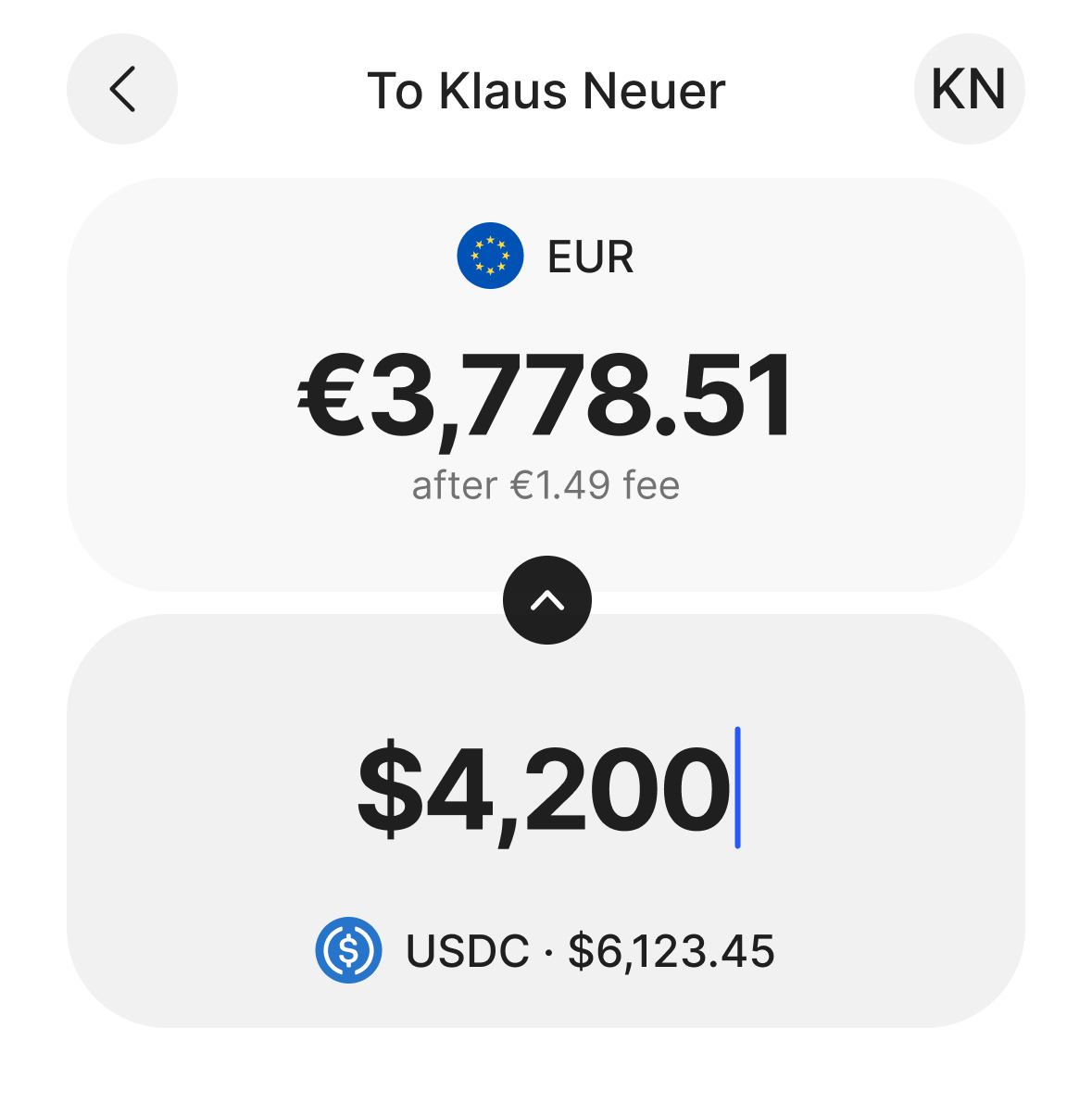
Due pays out rupees to Indian bank accounts over UPI and IMPS, with instant settlement, through the same API that covers payouts in 80+ countries. Platforms fund payouts from stablecoins such as USDC and USDT, or from fiat balances such as USD, EUR and GBP, and Due handles the conversion to INR.
What that looks like in practice:
- Instant rails: INR payouts go over UPI or IMPS, so recipients are credited in seconds
- One integration: The same transfer flow covers India and Due's other payout corridors
- Purpose codes in the API: Each payout channel lists the purpose codes it accepts, and the code is required where the channel needs one
- Stablecoin funding: Platforms can settle in stablecoins instead of pre-funding a rupee balance
Sorbet, a business account platform for SMBs and freelancers in the Gulf, uses Due for payouts in several currencies, including INR. Read how Sorbet built its payout coverage on Due.
Due's India coverage is payouts only. INR collections and INR virtual accounts are not available today.
Book a demo to see how INR payouts would fit your platform.


FAQs: India payments
What is the difference between UPI and IMPS?
Both are instant, 24/7 rails run by NPCI. UPI is addressed by UPI ID or account number and IFSC and is capped at ₹1 lakh for most person-to-person payments. IMPS is addressed by account number and IFSC or mobile number and MMID, with a ₹5 lakh cap per transaction.
What is the UPI transaction limit?
The standard person-to-person limit is ₹1 lakh per transaction. Since September 15, 2025, selected categories such as capital markets, insurance, travel and business collections allow up to ₹5 lakh per transaction.
How long does an NEFT transfer take?
NEFT runs 24/7 and settles in half-hourly batches. RBI requires banks to credit the beneficiary, or return the funds, within two hours of the batch settling.
What is the minimum amount for RTGS?
The RTGS minimum is ₹2 lakh, with no upper limit. Each payment settles individually and in real time, 24/7.
Can a company outside India pay out to Indian bank accounts over UPI?
Not directly. Money from abroad has to enter India through a licensed channel, such as a SWIFT wire to an authorized dealer bank, before it moves over UPI or IMPS. Most platforms use a payout provider with a licensed partner in India to do this.