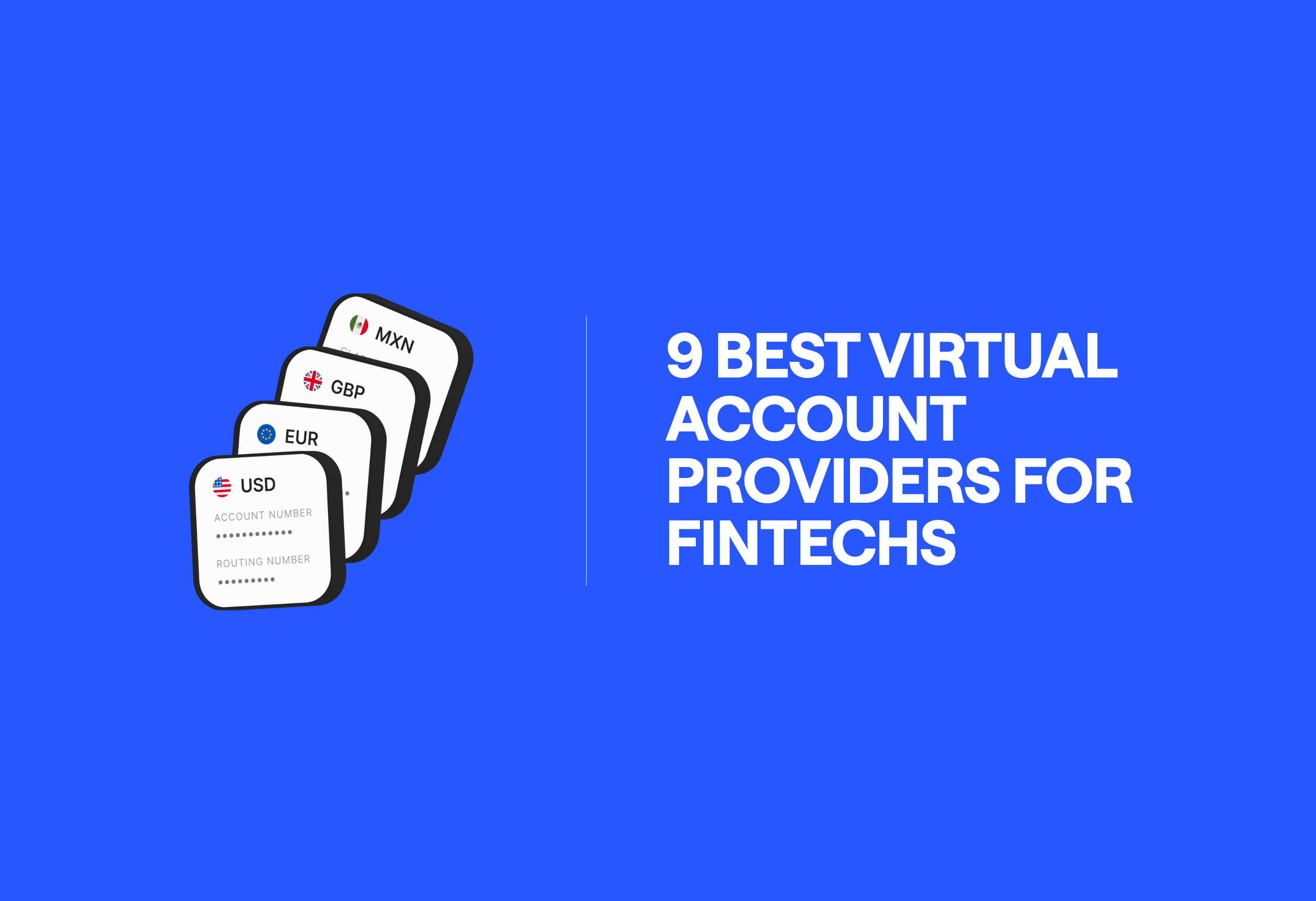




9 best virtual account providers for fintechs
- Virtual account providers split into stablecoin-native platforms and traditional EMIs and payment companies
- The biggest differences are which currencies come as named accounts, who can send funds in, and where deposits settle
- Due issues named USD, EUR, GBP and AED accounts plus local receiving details through one API, settling to stablecoins or local currency
The best virtual account provider for a fintech depends on three things: which currencies your users need, whether accounts must be in each user's own name, and where deposits should settle. This guide compares nine providers on those points, starting with Due, which issues named USD, EUR, GBP and AED accounts through one API and settles deposits to stablecoins or local currency.
The category is consolidating fast. Stripe completed its acquisition of Bridge in February 2025, and Mastercard closed its acquisition of BVNK in August 2026, in a deal valued at up to $1.8 billion. Traditional providers are moving the other way: Rapyd added stablecoin settlement in 2025, and Airwallex says it is building stablecoin support.
That leaves fintechs choosing between two groups that now overlap. The comparison below covers both, using each provider's own documentation as of October 2026.
How we compared virtual account providers
Each provider was assessed on six criteria that decide whether its accounts will work for a fintech's end users. Every fact comes from the provider's own documentation, product pages or press releases, or from a regulator.
- Receiving currencies and rails. Which currencies come with local details, and which inbound rails each one accepts.
- Account naming. Whether details carry the end user's name, which matters for payroll and marketplace payouts.
- Who can pay in. Whether third parties can fund the account or only the account holder.
- Settlement. Whether deposits stay in fiat, convert to stablecoins automatically, or pay out locally.
- End-user issuance. Whether a platform can create accounts for its own customers by API.
- Licensing. Which regulated entities stand behind the accounts.
Pricing is not compared because none of the nine providers publishes platform pricing for virtual accounts. Facts not stated in official sources are marked as such rather than assumed.
The 9 best virtual account providers for fintechs
The first five providers are stablecoin-native: deposits can settle on-chain. The last four are global payment platforms and EMIs built on bank rails.
1. Due
Due is a payments infrastructure API that issues virtual accounts to a platform's end users and settles deposits to stablecoins or local currency. It serves fintechs, neobanks, wallets, payroll platforms and remittance businesses.
Best for: Platforms with users in emerging markets that need named USD, EUR, GBP and AED accounts plus local receiving details, all settling into one stablecoin or payout flow.
How Due virtual accounts work? A platform creates an account for each user, completes KYC or KYB, and requests the currency channel it needs. Due issues the receiving details by API. When a deposit lands, Due matches it to the user and settles it to the destination set on the account, such as a stablecoin wallet, a bank account or a local payout, with webhooks at each step.
Pay-in settlement times on Due's main receiving rails:
- Fedwire: under 2 hours
- ACH: T+0 to T+1
- SWIFT (USD): T+1 to T+3
- SEPA Instant: instant, up to €100,000 per transaction
- Faster Payments: instant, up to £1,000,000 per transaction
- AED: instant on IPP up to AED 50,000, or under 2 hours on FTS
Beyond the accounts themselves, platforms get the pieces needed to run them as a product:
- Reusable verification. Import Sumsub KYC and KYB from other platforms, or send users to a hosted flow for only the steps still missing.
- Your own margin. Add an application fee in basis points to deposits, or subsidize Due's fees, including FX.
- Free on-chain payouts. On-chain payouts are free, including cross-chain transfers, per Due's fees page.
- Wallet flexibility. Settle to Due's MPC wallets secured by passkeys, or keep users' own wallets, with signing support for Privy and Kernel smart accounts.
- Stablecoin deposits too. Stablecoin virtual accounts on eight chains can receive USDC or USDT and settle them to fiat automatically.
In practice: Rizon uses Due to give freelancers and remote workers USD, EUR, GBP, AED and MXN accounts, with deposits converting into their Rizon wallet.
Considerations: BRL (Pix) collection is currently suspended, and AUD details are issued in Due's name rather than the user's. EUR accounts are named once an extra eligibility check is approved, and USDT is not available to EU clients. Due does not currently offer card issuing.
Sources: Due supported payment methods, networks and tokens, fees (October 2026).
2. Bridge
Bridge is a stablecoin infrastructure provider owned by Stripe since February 2025. It issues virtual accounts to KYC- or KYB-approved customers and converts deposits to stablecoins.
Best for: US-focused platforms that want stablecoin settlement backed by a large payments group.
Bridge runs KYC and KYB itself, through its API or hosted KYC links. Once a customer is approved, the platform creates a virtual account that names a source currency and a crypto destination. Deposits convert automatically and land in that wallet, with webhooks as funds arrive and settle. Bridge's virtual accounts handle the on-ramp only; payouts to banks run through separate transfers or liquidation addresses.
Strengths:
- Latin American collection. Local accounts in Mexico, Brazil and Colombia, alongside USD and EUR.
- Instant US pay-ins. FedNow is an inbound rail on USD accounts, next to ACH and wire.
- Flexible developer fees. A percentage or flat-plus-percent fee on deposits, paid out monthly.
- Backing. Owned by Stripe, with a conditional OCC charter for a national trust bank.
Considerations:
- Bridge does not serve customers based in New York, and EU customers cannot use the MXN, BRL, GBP or COP rails.
- Some rails are capped: Pix deposits at a $500,000 equivalent per customer per month, and SPEI third-party payments from individuals at 15,000 MXN.
- SWIFT inbound is not documented, and pricing is through sales only. For other options, see our guide to Bridge alternatives.
Sources: Bridge virtual accounts docs, rail limits, supported countries, legal and licenses (checked October 2026).
3. BVNK
BVNK is a stablecoin payments infrastructure provider that Mastercard acquired in August 2026. It issues named virtual IBANs to a platform's customers.
Best for: Licensed financial services firms that want USD, EUR and GBP accounts with stablecoin conversion.
Platforms create each customer by API, as a company or an individual, and open a fiat wallet per currency with its own account details. Deposits stay in fiat by default. To send them on-chain, the platform sets a payment rule that converts each incoming payment and forwards it to a blockchain address, with an optional flat fee.
Strengths:
- Licensing depth. Regulated in the UK, EU and US, and part of Mastercard since August 2026.
- Reliance onboarding. Regulated partners can onboard customers on their own KYC.
- Settlement speed. SEPA Instant pay-ins settle in seconds and standard ACH in T+1, per BVNK's docs.
- No pay-in limits. BVNK accepts all incoming transactions; limits apply to payouts only.
Considerations:
- Customer virtual accounts are only for regulated PSPs and financial institutions, and BVNK's site lists a $500,000 monthly volume minimum.
- Availability covers the UK, US businesses and supported countries outside the EEA. GBP accounts are limited to companies incorporated in the UK and a few Crown territories.
- US money transmitter licenses do not include California or New York. Our BVNK alternatives guide covers other providers.
Sources: BVNK virtual accounts docs, fiat pay-ins, payment methods, licensing, customer virtual accounts (checked October 2026).
4. Conduit
Conduit is a cross-border payments provider that issues multi-currency virtual accounts to businesses through its API, with no US entity required.
Best for: Businesses and B2B platforms that need USD receiving details for international trade flows.
Once a customer is active, the platform applies for a virtual account in each currency and reads the deposit details after an approval webhook. Funds stay in fiat until the platform creates an order to convert them, which can execute automatically and pay out onward. Platforms add their own margin in basis points on each order.
Strengths:
- USD rail depth. ACH, Fedwire, RTP, FedNow and SWIFT pay-ins for businesses without a US entity.
- Flexible onboarding. Hosted verification links, plus optional KYC reliance.
- Wide payout rails. US rails, SEPA, Faster Payments, CHAPS and SWIFT.
Considerations:
- Conduit's docs state that it refuses live on-ramps and off-ramps for customers in the United States.
- EUR and GBP accounts launched in early access in December 2025, and individual customers must be enabled per platform.
- Conversion is a separate step rather than automatic.
Sources: Conduit virtual accounts docs, on-ramp rules, KYB coverage, licensing (checked October 2026).
5. Noah
Noah is a stablecoin infrastructure provider that converts bank deposits into stablecoins sent to an on-chain address.
Best for: Wallets and on-ramp products that move individual users' deposits straight on-chain.
A platform onboards each customer, then creates a deposit workflow that names the currency, stablecoin, network and wallet address. The customer receives bank details, and every deposit converts automatically and can be withdrawn straight to that wallet. Platforms can withhold their own fee during conversion.
Strengths:
- Destination choice. USDC on Base, Celo, Ethereum, Gnosis, Polygon, Solana and Tron, plus other stablecoins.
- Onboarding options. Hosted onboarding, Sumsub token sharing and a self-serve sandbox.
- Payouts. 120+ currencies across 60+ countries, per Noah's docs.
- Individuals and businesses. Both are supported, according to Noah's product pages.
Considerations:
- Low default limits: USD deposits over $10,000 per transaction or $20,000 per month trigger enhanced due diligence, and unrelated third parties can send non-US residents up to $5,000.
- The UK is on Noah's prohibited list, and US residents cannot get EUR accounts.
- USD accounts require Noah's own KYC; reliance on a platform's checks works for EUR only.
Sources: Noah USD on-ramp docs, EUR on-ramp docs, supported countries, KYC, licences, Latvijas Banka announcement via LV portals (checked October 2026).
6. Airwallex
Airwallex is a global payments platform whose Global Accounts can be issued to a platform's connected accounts through its embedded finance API.
Best for: Platforms whose users need accounts in many developed-market currencies with built-in FX.
Platforms create a connected account for each customer, complete onboarding through an embedded component, hosted flow or API, and open Global Accounts on that customer's behalf. Funds land in the connected account's multi-currency wallet, where they can be converted and paid out. Airwallex runs the identity checks.
Strengths:
- Developed-market coverage. Local details in 16 regions, including Hong Kong, Singapore, Australia and Canada.
- Payout reach. 200+ countries, with local rails in 120+.
- Platform revenue. FX markups of up to 20% and fixed or percentage transfer fees.
- Onboarding reach. Full accounts for customers registered in 55 markets.
Considerations:
- Stablecoin features are early-stage: stablecoin transfers are API-only, USDC on Ethereum, with no sandbox.
- There is no reliance model, so platforms cannot onboard customers on their own KYC.
- Customers outside the 55 full-account markets get restricted account types.
Sources: Airwallex coverage docs, connected accounts, regional availability, stablecoin transfers, regulation (checked October 2026).
7. Currencycloud
Currencycloud is a cross-border payments provider that Visa acquired in 2021. Platforms can create sub-accounts for their customers, each with its own multi-currency wallet.
Best for: Regulated and unregulated platforms that need local collections in major currencies plus wide SWIFT coverage.
Platforms create a sub-account for each customer, retrieve its funding details by API and act on its behalf when converting or paying out. Webhooks report deposits as pending and completed. Platforms can also opt in to approve or reject each deposit within 23.5 hours.
Strengths:
- Three onboarding models. Regulated platforms run their own KYC, unregulated platforms rely on Currencycloud's, or platforms run outsourced KYC to its standards.
- Fast local collection. GBP arrives in seconds, and USD received before 5pm EST is credited the same day.
- Global reach. Collections from 180+ countries and payouts to 180+.
- Backing. Owned by Visa since 2021.
Considerations:
- Local USD accounts are unavailable in 61 countries, including Nigeria, Mexico, the UAE and Turkey.
- EUR collections run on SEPA Credit only, with no documented SEPA Instant.
- No stablecoin features, and webhook setup goes through a solutions manager.
Sources: Currencycloud collections overview, referencing funds, local USD restrictions, sub-accounts, regulation (checked October 2026).
8. Rapyd
Rapyd is a global payments platform that issues virtual accounts to wallets created on its platform, with optional conversion on arrival.
Best for: Platforms already using Rapyd for collections and payouts that want receiving accounts on the same stack.
Platforms create a Rapyd Wallet for each person or company, verify the owner and issue one or more virtual accounts to it. Deposits land in the wallet's balance or convert to a requested currency. From there, funds settle to a bank account or pay out through Rapyd Disburse.
Strengths:
- No local presence needed. Clients do not need to be based in the issuing country.
- Multi-currency receiving. Danish and Singapore accounts receive 21 and 11 currencies.
- Payouts. 100+ countries through bank transfer, e-wallet, card and cash.
- Testing. A sandbox with simulated deposits, plus webhooks for completed and rejected deposits.
Considerations:
- Wallets are generally credited within one business day after compliance checks, slower than instant rails elsewhere.
- Rapyd's docs list 8 issuing markets, far fewer than the 40+ countries on its marketing pages.
- Rapyd does not issue or custody crypto assets itself, and no platform fee mechanism is documented for deposits.
Sources: Rapyd virtual accounts docs, issuing to wallets, UK account terms, regulatory framework (checked October 2026).
9. Modulr
Modulr is a UK and EU electronic money institution that issues per-customer accounts by API. Since August 2026, it has been a direct participant in Faster Payments, Bacs and CHAPS.
Best for: UK and EEA platforms that need GBP and EUR accounts with direct UK payment scheme access.
Platforms create a customer, open accounts under it with a currency and product code, and receive the pay-in details in the response. Faster Payments and Bacs are on by default, while CHAPS, SEPA and SEPA Instant are enabled on request.
Strengths:
- Direct scheme access. A direct participant in Faster Payments, Bacs and CHAPS since August 2026, which Modulr says no other non-bank PSP has.
- High limits. Faster Payments up to £1 million in and out.
- Own-KYC option. Regulated institutions can run their own KYC through the Payment Clearing Model.
- Operations tooling. Webhooks for compliance holds and account status, and a sandbox with test funds.
Considerations:
- Customers contract through Modulr's UK or Dutch entity, so it does not serve users outside the UK, Gibraltar and EEA.
- US accounts are still in pilot, through a bank partnership announced in September 2026.
- No stablecoin settlement.
Sources: Modulr customers and accounts docs, inbound payments, name checks, licensing (checked October 2026).
How to choose a virtual account provider for your fintech
The right provider is the one whose currencies, naming and settlement match how your users get paid. Work through these checks before you shortlist.
- Map who pays your users. List the payers your users depend on and the currency and rail each one uses. A freelancer paid by US platforms needs ACH and wire details, while a supplier invoicing European clients needs a virtual IBAN.
- Decide between named and pooled accounts. Named accounts carry each user's own name, which payroll and marketplace payers often check. Pooled structures such as an FBO account suit closed-loop products where money mostly moves inside your app.
- Check who can pay in, currency by currency. Some providers accept third-party payments on one currency but not another. A first-party-only rule will block a freelancer's clients from paying in.
- Choose where deposits settle. Wallets and stablecoin apps need automatic conversion on the chains they support. Platforms paying out locally need payout rails in their users' countries.
- Confirm the onboarding model. Find out who runs KYC and KYB, whether existing verifications can be reused, and whether you need your own license to issue accounts.
- Ask how funds are held. Ask whose name is on the underlying bank account, who keeps the ledger and how often it is reconciled. Our guide to offering US bank accounts to non-US residents covers these questions in detail.
If your users span emerging markets and need named USD, EUR, GBP or AED accounts, book a demo to see how Due fits your user base and corridors. For a wider view of stablecoin infrastructure beyond virtual accounts, see our comparison of the best stablecoin payment providers.


FAQ: virtual account providers for fintechs
What is a virtual account provider?
A virtual account provider issues unique bank receiving details, such as an account and routing number or an IBAN, that a fintech can assign to each of its users. The provider holds the underlying bank or EMI relationships and matches incoming payments to the right user.
What is the difference between named and pooled virtual accounts?
Named virtual accounts show the end user's name as the account holder. Pooled accounts show the platform's or provider's name, and payments are matched by sub-account number or reference. Named accounts work better when outside payers check the payee name.
Can fintechs issue virtual accounts without a banking license?
Yes. Most providers on this list let unlicensed platforms issue accounts to their users, with the provider running KYC and holding the regulated relationships. Some models, including BVNK's customer virtual accounts, require the platform to hold its own financial services license.
Which virtual account providers settle deposits to stablecoins?
Due, Bridge, BVNK and Noah can convert deposits to stablecoins automatically. Conduit converts through a separate order, Rapyd offers stablecoin settlement through partners, and Airwallex says stablecoin support is in development.
Do virtual accounts accept payments from third parties?
It depends on the provider and currency. On Due, USD, EUR, AED, MXN, NGN and COP accept third-party payments, while GBP and AUD are first-party only. Check each currency before launch, because a first-party-only rule blocks clients and employers from paying in.