



SWIFT vs Ripple: Cross-Border Payment Speed and Cost Comparison
- SWIFT and Ripple are not direct replacements for each other. SWIFT is a messaging network used by banks to send payment instructions, while Ripple is blockchain-based payment and liquidity infrastructure. Comparing them as if they do the same job leads to the wrong conclusion.
- Ripple can be faster and cheaper in the right markets, but not everywhere. XRP Ledger settlement happens in seconds, but the full payment still depends on liquidity, FX conversion, compliance checks, and local payout partners. SWIFT has also improved, with many payments now reaching beneficiary banks within minutes.
- The right choice depends on the payment route, transaction size, and risk profile. SWIFT is still the stronger fit for large bank transfers and broad institutional coverage, while Ripple can work well for high-frequency payouts where liquidity and local partners are strong. Due gives teams one way to connect traditional rails and stablecoin settlement without building separate integrations for each payment method.
Most comparisons of SWIFT and Ripple frame the debate as old versus new, slow versus fast, expensive versus cheap. That framing produces confident-sounding conclusions that rarely hold up in practice.
The core problem is a category mismatch. SWIFT is a financial messaging network. Ripple is a settlement and liquidity layer. They solve different parts of the cross-border payment problem, which means direct comparisons often measure the wrong things. SWIFT does not move money. Ripple does not have the institutional reach of a network connecting more than 11,500 banks. Treating them as interchangeable options for the same use case is where most analyses go wrong.
The better question is which infrastructure fits a specific corridor, under specific liquidity conditions, at a specific transaction size. A USD-to-EUR payment through an optimized SWIFT GPI route looks very different from a USD-to-MXN payout through Ripple's On-Demand Liquidity.
This guide breaks down how SWIFT and Ripple work, where the FX costs and intermediary fees actually come from, what both networks are changing in 2026, and how to evaluate which rail makes sense for a given payment corridor.
SWIFT vs Ripple: quick comparison
What is SWIFT and how does it work?
The Society for Worldwide Interbank Financial Telecommunication (SWIFT) was founded in the 1970s as a secure messaging network linking banks. Today, it connects more than 11,500 financial institutions across more than 200 countries and territories.
SWIFT is messaging, not settlement
A common misunderstanding is that SWIFT moves money. It does not. SWIFT transmits standardized payment instructions between banks. The actual movement of funds happens through correspondent banking relationships, where banks hold pre-funded nostro and vostro accounts in foreign currencies to facilitate settlement.
If the sending and receiving banks do not have a direct relationship, the instruction passes through one or more correspondent banks. Each intermediary may deduct a fee, apply its own FX spread, and run its own compliance checks. This design gives SWIFT enormous institutional reach. It also explains why traditional SWIFT wires can take one to five business days and cost US$25-50 in base fees before FX mark-ups.
SWIFT GPI improvements
SWIFT has made material improvements through Global Payments Innovation (GPI), which added end-to-end payment tracking, fee transparency, and faster routing. According to SWIFT's published network data, 75% of payments traveling over its network now reach beneficiary banks within 10 minutes.
These improvements still rely on correspondent banking infrastructure, however. GPI can move the instruction quickly, but final credit to the recipient depends on the beneficiary bank's processing, local clearing systems, FX controls, and compliance checks at each step in the chain. SWIFT may deliver the instruction to the beneficiary bank in minutes, but that does not always mean the recipient has usable funds immediately.
What SWIFT is changing in 2026
SWIFT is in the middle of its most significant infrastructure shift in decades, and any current comparison with Ripple needs to account for it. Two parallel initiatives matter most.
- SWIFT is adding a blockchain-based shared ledger to its infrastructure stack. Announced at Sibos in September 2025 and developed with more than 40 financial institutions, the ledger is designed to enable 24/7 real-time cross-border payments using tokenized deposits.The ledger is built on an EVM-compatible architecture based on Hyperledger Besu and builds on SWIFT's existing standards work, including the ISO 20022 messaging migration. SWIFT plans to run live transactions through the minimum viable product in 2026. Rather than replacing existing rails, it acts as an orchestration layer that validates and synchronizes interbank payment commitments before execution.
- SWIFT is rolling out a new payments scheme for retail transactions. More than 25 banks are going live by the end of June 2026, covering corridors into markets including Australia, Bangladesh, Canada, China, Germany, India, Pakistan, Spain, Thailand, the UK, and the US. The scheme commits participating banks to upfront cost certainty, full-value delivery, end-to-end traceability, and instant settlement where local infrastructure allows.
The strategic point is hard to miss: the incumbent messaging network is adopting the same blockchain settlement concepts that Ripple built its pitch around, while keeping its institutional reach. This narrows the speed argument over time, though it does not eliminate the liquidity and pre-funding differences covered below.
What is Ripple and how does it work?
Ripple is a financial technology company focused on blockchain-based payment and liquidity infrastructure. For cross-border payments, Ripple uses the XRP Ledger (XRPL) and, through its On-Demand Liquidity (ODL) model, XRP as a bridge asset between currencies. Ripple now markets its cross-border offering under the Ripple Payments brand (formerly RippleNet), though ODL remains the standard term for XRP bridge flows. Ripple also issues RLUSD, a US dollar stablecoin, under a New York limited purpose trust charter.
The XRPL is an open-source blockchain that settles transactions in approximately three to five seconds, with a network fee of a fraction of a cent at the ledger level. It uses a consensus protocol rather than energy-intensive mining.
How On-Demand Liquidity works
ODL eliminates the need for payment providers to pre-fund accounts in destination currencies. Rather than holding a balance in MXN before sending to Mexico, a provider sources liquidity at the time of payment:
- The sender funds the payment in their local currency.
- The provider converts funds into XRP.
- XRP moves across the XRPL in seconds.
- XRP is converted into the destination currency by a local payout partner.
- Funds arrive in the beneficiary's account via local rails.
This reduces reliance on pre-funded nostro accounts, which lock up significant working capital for providers operating across many currencies. ODL's effectiveness depends on XRP liquidity depth in the corridor. In markets where liquidity is thin, conversion costs increase and settlement may be less reliable.
Is Ripple faster than SWIFT?
At the ledger level, yes: XRPL transactions settle in seconds, while traditional correspondent banking payments can take days when multiple intermediaries, time zones, cut-off times, or compliance reviews are involved. But ledger speed is the easiest part of this comparison to oversimplify. The useful comparison is end-to-end payment speed, not network speed.
For SWIFT, the main variables are:
- Sending-bank processing
- Cut-off times
- Intermediary routing
- Compliance checks
- FX controls
- Local clearing systems
- Beneficiary-bank processing
GPI has compressed most of these steps, yet the last mile remains outside SWIFT's direct control.
For Ripple, ledger settlement takes seconds, but the full payment depends on:
- Source-currency funding
- XRP liquidity
- Exchange execution
- Destination-currency conversion
- Compliance screening
- Local payout partner
The honest claim is not that Ripple always settles payments in seconds. It is that Ripple can settle the digital asset leg in seconds, while end-to-end payout speed depends on fiat endpoints and local market infrastructure.
How that plays out varies by use case:
Is Ripple cheaper than SWIFT?
Ripple can be cheaper in supported corridors, but neither system has a universal price, and this is where comparisons most often become misleading. Total cost depends on the provider, corridor, transaction size, FX spread, intermediary chain, and payout method.
For context, the World Bank's Remittance Prices Worldwide database shows that sending remittances still costs several percentage points of the amount sent on average, but remittance pricing is not a direct proxy for B2B cross-border payments or enterprise flows.
The cost structure differs significantly between the two:
SWIFT's higher costs in many corridors stem from three structural factors. Each bank in the correspondent chain charges its own fee and applies its own FX spread. Banks and providers must maintain pre-funded balances in recipient currencies, which creates ongoing liquidity costs. And senders rarely know the total cost before initiating a transfer, which makes comparison shopping difficult.
Ripple reduces some of these costs in supported corridors. The ledger fee itself is negligible. But on/off-ramp fees, liquidity spreads, provider margins, and payout partner charges still apply. The right comparison is always corridor-specific, not network-wide.
Liquidity and pre-funding: the structural difference
Liquidity is the most structural difference between the two systems, and the one least affected by SWIFT's speed improvements.
In correspondent banking, liquidity is pre-positioned. Banks and payment providers hold balances in foreign accounts so they can settle in local currency. This creates reach, but it ties up capital and complicates liquidity management. For providers operating across many markets, pre-funding becomes expensive and operationally complex.
Ripple's ODL model is designed to solve exactly this problem by sourcing liquidity at the time of payment. That is valuable when a corridor has high payment volume, digital asset liquidity is deep, fiat on/off-ramps are reliable, and the provider wants to reduce idle capital. It is not automatic: where liquidity is thin, regulatory treatment is uncertain, or payout coverage is weak, the advantage shrinks.
Stablecoin settlement offers a third approach to the same pre-funding problem, using fiat-pegged digital assets rather than a volatile bridge asset. That is one reason many payment providers now evaluate stablecoins in cross-border payments alongside both SWIFT and Ripple.
Coverage and adoption
SWIFT wins on institutional reach. Its 11,500+ connected institutions across 200+ countries make it the default for banks, regulated financial institutions, and large-value treasury flows, with decades of integration into compliance, reconciliation, and banking operations.
Ripple's coverage works differently. It depends on payout markets, local partners, liquidity access, and digital asset infrastructure. According to Ripple and Thunes' expanded partnership announcement, Ripple Payments covers 90+ payout markets and has processed more than US$70 billion in volume. That is meaningful coverage, but it is not the same as SWIFT's bank-to-bank ubiquity. Ripple is strongest where its payout partners, liquidity infrastructure, and regulatory setup align with the corridor.
Compliance and risk
SWIFT is deeply embedded in the regulated banking system. Banks using SWIFT perform their own sanctions screening, KYC and AML checks, and regulatory reporting; SWIFT provides the secure messaging layer, while compliance responsibility sits with the participating institutions.
Ripple operates in a different regulatory environment, and that environment is improving. In December 2025, the OCC granted preliminary conditional approval for a de novo national trust bank charter for Ripple National Trust Bank, though the bank cannot begin operations until final approval is granted. In the EU, MiCA provides an emerging framework for digital asset payment activity.
Digital assets still introduce considerations that traditional rails do not:
- The legal treatment of XRP in each operating jurisdiction
- Licensing requirements for cryptoasset activity
- Market and liquidity risk on the digital asset leg
- Counterparty exposure to exchanges and liquidity providers
- Wallet and custody requirements
ODL minimizes FX volatility exposure by converting within seconds, but some treasurers prefer not to touch digital assets at all, while others are comfortable using a provider that abstracts the digital asset leg away entirely. The right answer depends on the institution's risk appetite, regulatory obligations, and operating markets.
When to use SWIFT and when to use Ripple
The choice between SWIFT and Ripple depends on more than speed and cost. The patterns below cover most decisions.
Use SWIFT when:
- Broad institutional bank coverage is required
- Transfers need to reach traditional bank accounts in long-tail markets
- Large-value corporate or treasury transfers are involved
- Regulatory comfort with established infrastructure is a priority
- The corridor has limited digital asset liquidity or restrictive digital asset rules
Use Ripple when:
- Settlement speed in a supported corridor is the main constraint
- Reducing pre-funding and idle capital across currencies is a priority
- The payment flow is high-frequency or remittance-style
- Local payout partners and XRP liquidity are strong in the target market
Does Ripple replace SWIFT?
Not generally. Ripple competes with SWIFT-enabled correspondent banking in specific payment flows, especially where the goal is faster settlement or lower pre-funding. But SWIFT remains the dominant financial messaging network for global financial institutions, and its 2026 ledger initiative shows it is absorbing blockchain settlement concepts rather than ceding ground to them.
In practice, cross-border payments are a routing problem, not a binary choice. A single business may use SWIFT for large bank transfers, local rails like SPEI in Mexico or PIX in Brazil for domestic payouts, stablecoins for 24/7 treasury movement, and digital asset infrastructure for liquidity-efficient corridors.
Good payment orchestration considers the corridor, currency pair, payment size, payout method, required speed, total cost, compliance risk, and liquidity availability. Understanding this as a routing problem, not a SWIFT alternatives shopping exercise, is what separates cost-efficient operators from those paying legacy rates on every corridor.
Route payments across both worlds with Due
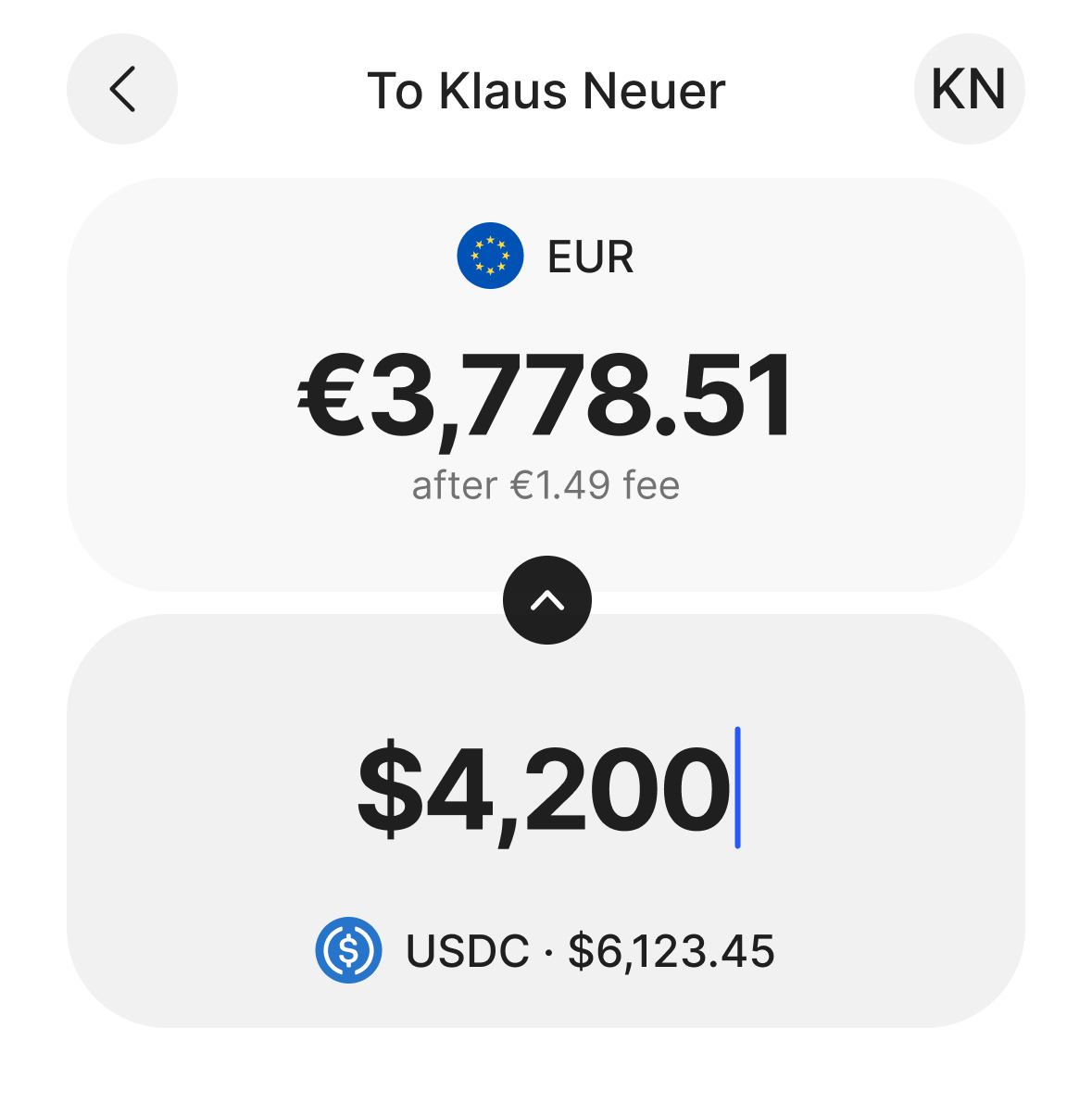
Due connects traditional banking rails and stablecoin networks through a single API, so businesses can route each payment through the most appropriate infrastructure for that corridor, without building separate integrations for bank transfers, local rails, and digital settlement.
With Due, teams can access:
- Local payment rails across 80+ markets for collections and payouts
- SWIFT payouts to 150+ countries
- Multi-currency virtual accounts in AED, BRL, COP, EUR, GBP, MXN, NGN, PHP, and USD
- Stablecoin rails (USDC, USDT, EURC) to reduce pre-funding and idle capital
- Settlement in 30+ currencies, instantly or within 24 hours
The practical benefit is flexibility. A fintech might use local rails for low-cost domestic payouts, SWIFT for a bank transfer to a long-tail market, and stablecoin settlement for faster treasury movement between entities. The user sees a single payment experience, while the infrastructure routes each payment through the best available path.
Talk to the Due team to see which corridors are live for your use case.


Frequently Asked Questions
What is the difference between SWIFT and Ripple?
SWIFT is a financial messaging network that banks use to exchange payment instructions. It does not move funds directly. Ripple is payments and liquidity infrastructure that uses blockchain settlement and digital assets to move value across borders. The two systems solve related but distinct problems in the cross-border payment stack.
Is Ripple faster than SWIFT for cross-border payments?
Ripple is faster at the ledger settlement layer, where XRPL transactions settle in three to five seconds. SWIFT has also improved materially: 75% of payments on its network reach beneficiary banks within 10 minutes. End-to-end delivery time for both systems depends on last-mile payout infrastructure, liquidity, and recipient bank processing.
Is Ripple cheaper than SWIFT for international transfers?
Ripple can be cheaper in supported corridors where it reduces correspondent banking intermediaries and pre-funding requirements. Total cost depends on XRP liquidity, on/off-ramp pricing, FX conversion, and payout fees. SWIFT costs also vary by bank, corridor, and FX spread. Neither has a universal price.
Does Ripple use XRP for every payment?
No. Ripple Payments supports different payment flows. XRP is most relevant when used as a bridge asset in On-Demand Liquidity flows, but not every Ripple-related payment requires XRP exposure for the end customer.