



To accept crypto payments, a business needs:
- A way to receive the payment
- Settlement rule
- Reconciliation process
That usually means choosing between a direct wallet, a crypto payment gateway that converts payments to fiat, or API-based payment infrastructure like Due for pay-ins, conversion, and payouts.
The settlement decision matters most. Businesses can hold the original crypto, convert payments to fiat, or settle in stablecoins like USDC, USDT, or EURC. Most businesses choose fiat or stablecoin settlement to avoid volatility and keep the amount received close to the amount invoiced.
The Bank for International Settlements puts quarterly cross-border volume for the two largest stablecoins at over $400 billion, which helps explain why accepting crypto increasingly means accepting stablecoin payments. Setup can be fast, but a clean launch depends on deciding which assets to accept, who holds funds, when conversion happens, and how refunds and reconciliation work.
This guide covers the three acceptance models, how payments move from checkout to settlement, a seven-step launch plan, costs, compliance basics, and the operational details to define before going live.
Three ways to accept crypto payments
Every crypto acceptance setup is a version of one of three models. The right one depends on your volume and on what role payments play in your business.
Direct wallet: full control, full burden
The simplest setup is also the most demanding. You create a wallet, share the address, and customers pay you directly. There are no provider fees and no middleman.
In exchange, you take on everything a provider would handle. You manage custody and keys, and a lost key means lost funds. You carry full price exposure on every asset. You match incoming transactions to invoices by hand. And you convert to fiat yourself through an exchange or off-ramp, with its own KYC, fees, and timing. This works for a crypto-native team taking a few payments a month. It breaks down fast beyond that.
Crypto payment gateway: the checkout option
A gateway is a payment service provider for digital assets. The customer pays in crypto, the gateway verifies the transaction, converts it, and settles fiat to your bank account. You never touch the asset.
This is the default route for merchants. Setup is quick, often a payment link or a checkout plugin, and the provider handles volatility, custody, and reporting. The trade-offs are fees on every transaction, settlement on the provider's schedule, and limited flexibility. A gateway gives you a payment method. It does not give you payment capabilities you can build on.
Payment infrastructure: when payments are the product
Platforms, marketplaces, and fintechs need more than a checkout button. They need to accept funds on behalf of users, keep balances separated, convert between assets and currencies, and pay out across markets. That requires API-based payment infrastructure rather than a gateway.
The building blocks are pay-in addresses or virtual accounts per user, programmatic conversion, webhooks for reconciliation, and payout rails on the other side. The integration is heavier than a gateway, and the payoff is control: you decide what to accept, what to settle in, and when to convert. If payments are part of your product, this is the model that scales.
How a crypto payment flows from checkout to your bank account
Understanding the flow makes every later decision easier. A typical accepted payment moves through five stages.
- Payment initiation. The customer gets a wallet address, payment link, or QR code, usually with an amount locked for a short window. They send the payment from their wallet.
- On-chain confirmation. The transaction is recorded on the blockchain. Depending on the network, confirmation takes seconds to a few minutes. Once confirmed, the payment is final. There is no chargeback and no recall.
- Detection and matching. Your provider (or your own system) detects the incoming transaction and matches it to an order or invoice. This is where unique addresses or virtual accounts per customer earn their keep: matching becomes automatic instead of forensic.
- Conversion, or not. Based on your settlement policy, the payment converts to fiat immediately, converts to a stablecoin, or stays as received. The exchange rate at this moment is the one your books will care about.
- Payout and ledger entry. Settled funds move to your bank account or stay as a balance, and the transaction lands in your accounting with a reference, a rate, and a timestamp.
Stages one and two are blockchain mechanics and largely solved. Stages three to five are where providers differ and where your operational workload is decided. Evaluate providers on the back half of the flow, not the front.
Step-by-step process to add crypto as a payment method
With the models and the flow clear, the launch plan is straightforward. Work through these decisions in order.
Step 1: Decide which assets you will accept
Accepting everything is not a strategy. Each asset adds operational and accounting overhead. A practical default is to accept the major stablecoins (USDC, USDT, and EURC for euro businesses) plus bitcoin and ether if your customers actually hold them. If you are unsure, start with stablecoins. They cover most business payment volume. They also behave like the currencies your accounting already understands.
Step 2: Choose your acceptance model
This is the wallet vs gateway vs infrastructure decision covered above. The short version: a direct wallet for a handful of payments from crypto-native clients, a gateway to add crypto as a checkout option, and API infrastructure when payments are part of your product. Be honest about volume. The most common mistake is picking the wallet route to save fees and drowning in manual work three months later.
Step 3: Decide how you settle
You have three options, and you can mix them per asset or per flow:
- Auto-convert to fiat. Every payment converts to your home currency immediately. No volatility risk, simplest accounting, and you pay a conversion fee on every transaction.
- Settle in stablecoins. You receive and hold stablecoins, then convert to fiat when you choose. This keeps funds moving 24/7 and avoids converting twice when you also pay suppliers or contractors in stablecoins.
- Hold the crypto. Only sensible for assets you would buy anyway as a treasury decision. Holding customer payments in volatile assets turns your revenue into a trading position.
Step 4: Cover the compliance basics
The rules depend on where you operate and whether you touch customer funds. Three things cover most situations. Know your duties under KYC and AML rules. Be aware that larger transfers carry data-sharing duties under the crypto Travel Rule. And check the rules in your own market.
In the EU, MiCA now licenses crypto payment activity. In the US, the GENIUS Act set federal rules for stablecoin issuers. For taxes, the IRS treats digital assets as property, so receiving and later converting crypto can create taxable events.
The simplest path: use a licensed provider that settles you in fiat. That removes most of this burden. Ask your accountant about the rest.
Step 5: Plan accounting and reconciliation
Decide three things before launch: how each payment maps to an invoice, what exchange rate you record, and who matches blockchain transactions to your ledger. Gateways and infrastructure providers handle most of this through reporting and webhooks. With a direct wallet, reconciliation is on you, and it gets painful past a handful of transactions per month.
Step 6: Integrate the payment experience
The customer-facing part is the simplest. Options range from no-code to full API:
- Payment links and QR codes for invoices and one-off payments
- Checkout plugins for e-commerce platforms
- API integration for platforms that need payments inside their own product flow
- Virtual account details that let customers pay stablecoins like a bank transfer
Step 7: Test, then go live
Run a small test payment end to end before announcing anything: payment, confirmation, conversion, payout, and the entry in your books. It is the crypto equivalent of a penny test. Check that refund and underpayment cases have a defined process. Then switch it on.
Choosing the network: why the chain matters
The same stablecoin exists on many blockchains, and the choice of network changes the economics of each payment. A USDC transfer on Ethereum can cost several dollars in network fees at busy times. The same transfer on a newer Layer 1 like Solana, or a Layer 2 like Base, usually costs a fraction of a cent and confirms in seconds.
For most businesses, the practical rule is simple: support the networks your customers already use, and let your provider abstract the rest. Good providers accept payments across several chains and settle you in one place, so the network choice becomes the customer's convenience rather than your problem. What you should check is which networks a provider supports, because a missing network means failed or stuck payments from customers who hold funds there.
One operational warning: a payment sent on the wrong network, or to an address on a different chain, can be hard or impossible to recover. Clear payment instructions and address validation at checkout prevent most of these cases.
Why stablecoins became the default for business payments
Bitcoin gets the headlines, but it makes a difficult unit of account. If you invoice $10,000 and receive bitcoin, your revenue changes value before you finish your coffee. Businesses solved this in two ways: auto-converting volatile assets at the moment of payment, or invoicing in stablecoins from the start.
Stablecoins won because they remove the problem instead of managing it. The amount received equals the amount invoiced. Settlement is final in minutes, works on weekends, and crosses borders without correspondent banks. That is why stablecoins now do the heavy lifting in cross-border business payments, from contractor payouts to marketplace settlement. Even bitcoin-first setups usually convert to stablecoins or fiat behind the scenes.
For a business, this reframes the question. "Should we accept crypto?" usually means "should we accept stablecoin payments and settle them sensibly?" That version of the question has a much clearer business case.
What accepting crypto costs
There is no universal price, but the cost structure is consistent. Four components decide what you pay:
Compare this against your card costs. Crypto acceptance often comes in cheaper than cards for cross-border payments, where card fees, FX margins, and decline rates stack up. For domestic payments in markets with cheap local rails, the advantage is smaller. Run the numbers on your actual corridors instead of trusting generic claims. And remember there are no chargebacks, which is a real saving for businesses that deal with fraud.
Operational realities to plan for
The setup guides end at "go live." The issues below are what payment teams actually deal with in month two. None of them is a reason not to accept crypto. All of them are easier with a process defined in advance.
- Underpayments and overpayments. Customers paying from exchanges sometimes send slightly less than the invoice because the exchange deducts a withdrawal fee on their side. Decide your tolerance (accept within a small margin, or request a top-up) and automate the response.
- Refunds are new payments. There is no "void transaction" on a blockchain. A refund means collecting the customer's wallet address, sending a fresh payment, and paying a network fee. Define who approves refunds and which rate applies: the original crypto amount or the fiat value at payment time. The fiat value is the standard answer, but it has to be written down.
- Exchange rates and your books. Every conversion has a timestamp and a rate, and your accountant will want both. Providers that include the rate in transaction reporting save hours at month-end close. If you settle in stablecoins and convert later, the gap between receipt and conversion can create small gains or losses that need a ledger treatment.
- Wrong-network and lost payments. Some support tickets are unrecoverable, like funds sent to the wrong chain. Decide in advance what you will and will not compensate, and put address and network validation in the payment flow to keep these cases rare.
- Treasury policy for held balances. If you hold stablecoins between receipt and conversion, someone owns that decision. Set limits for how much sits in stablecoin, where it is held, and who can convert. This is standard liquidity management, applied to a new asset.
When accepting crypto makes sense, and when it does not
Crypto acceptance earns its keep in specific situations. It makes sense when you sell internationally and lose margin to card fees and FX. It makes sense when your customers are crypto-native, or sit in markets with weak card infrastructure. It also fits when chargebacks are a real cost, or when you pay suppliers and contractors globally and want money in, money out on the same rails.
It makes less sense when nearly all your customers are domestic card users, when your volume is too small to justify any new operational process, or when you would hold volatile assets without a treasury reason. Adding a payment method nobody uses is pure overhead. If you are unsure, look at where your customers are and where your payment costs actually come from.
Accepting stablecoin payments with Due
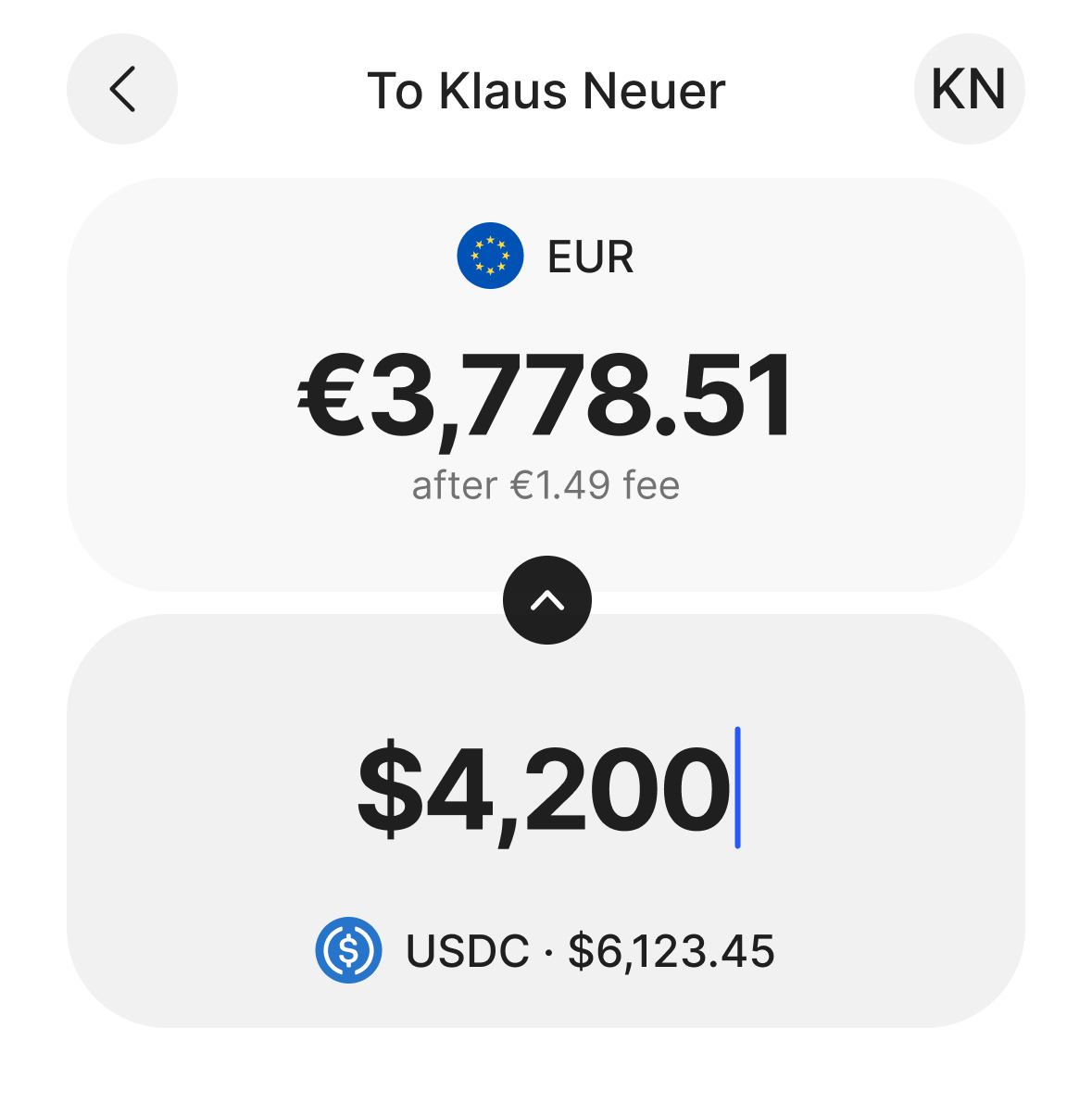
Due is payment infrastructure for businesses that treat payments as a product, not just a checkout option. Through a single API, businesses and fintechs can accept stablecoin payments and settle them wherever they need:
- Stablecoin pay-ins in USDC, USDT, and EURC, with unique virtual accounts per user for clean reconciliation
- Local currency accounts in AED, BRL, COP, EUR, GBP, MXN, NGN, PHP, and USD to collect fiat alongside crypto
- Conversion and payouts across 80+ markets on local rails, with settlement in 30+ currencies
- Non-custodial architecture, so you stay in control of funds
- MiCA authorization in the EU via Spain's CNMV
A marketplace can let sellers get paid in USDC and withdraw in their local currency. A platform can give each user a stablecoin account with bank-like details. A business can accept stablecoin invoices and pay suppliers from the same balance. The acceptance and the settlement live in one place.
Talk to the Due team to see how stablecoin acceptance fits your payment flows.


Frequently Asked Questions
Can a business accept crypto without holding crypto?
Yes. Gateways and payment infrastructure providers convert crypto to fiat automatically, so the business receives regular currency in its account. This is how most businesses accept crypto, because it removes volatility and custody risk.
Which cryptocurrencies should a business accept?
Start with major stablecoins (USDC, USDT, and EURC for euro invoicing), since they hold fixed value and cover most business payment volume. Add bitcoin and ether only if your customers actually want to pay with them, and auto-convert if you do.
Do crypto payments have chargebacks?
No. Blockchain payments are final once confirmed. That eliminates chargeback fraud, but it also means refunds must be sent as a separate payment, so you need a defined refund process.
What is the difference between a crypto gateway and payment infrastructure?
A gateway adds crypto as a checkout option and settles you in fiat. Payment infrastructure exposes pay-ins, conversion, accounts, and payouts through an API, so you can build payment flows into your own product. Merchants usually need a gateway; platforms and fintechs usually need infrastructure.
How much does it cost to accept crypto payments?
Expect a network fee (cents to a few dollars depending on the blockchain), a provider processing fee, a conversion spread if you settle in fiat, and a payout fee. For cross-border payments, the total is often lower than card acceptance. Compare against your real corridors.